What Different Domain Extensions Signal to Customers
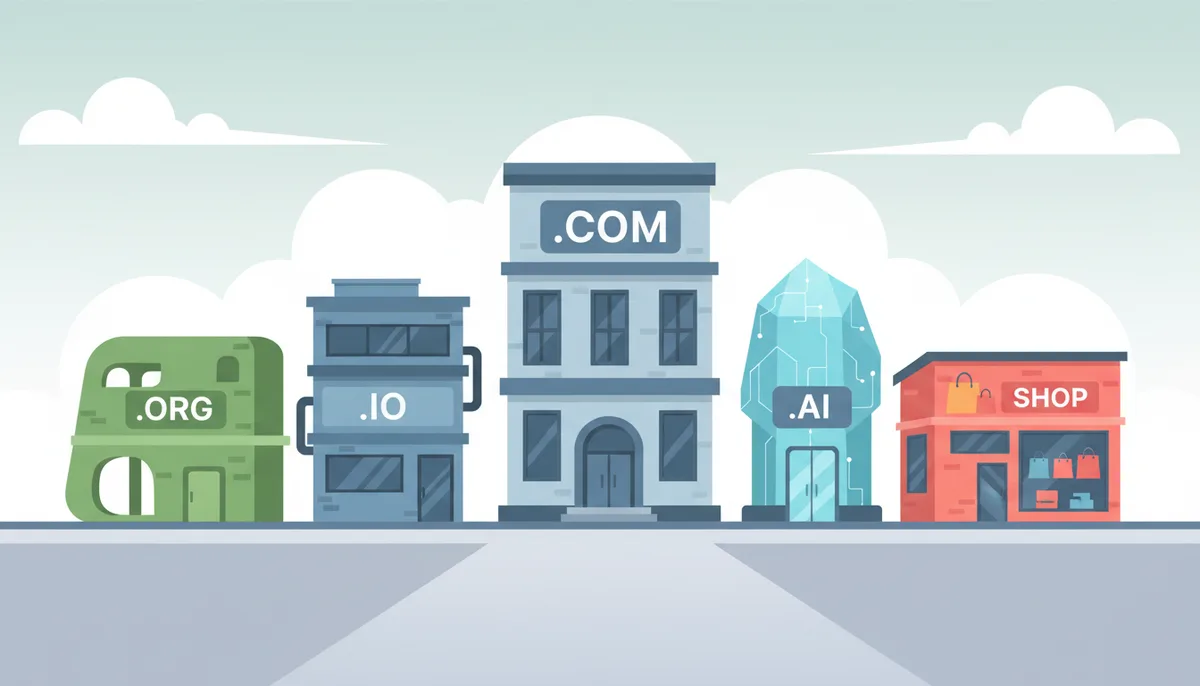
Imagine a customer typing your domain into their browser. Before they even see your landing page, the domain extension (.com, .org, .io) starts shaping their expectations. Just like a physical storefront in a well-known neighborhood, a domain extension sets the tone for your brand's credibility, trustworthiness, and purpose. In this guide, we'll explore the psychological signals each type of domain extension sends and how to choose the one that best represents your business.
Why Is Your Domain Extension More Than Just an Address?
Your domain extension is a powerful first impression. It influences how customers perceive your brand's scale, purpose, and legitimacy. Think of it this way: if your domain ends in .com, customers are more likely to trust that you're a global, established business. On the other hand, a .org might signal that you're a non-profit or community-driven organization. This initial assumption can set the stage for their entire experience on your site.
Like the neighborhood a physical store is in, a domain extension creates assumptions before a customer ever interacts with your content. The trade-off you face is the established trust of a classic TLD like .com versus the descriptive clarity or creative branding of a newer one like .io or .app.
How Are Domain Extensions Officially Categorized?
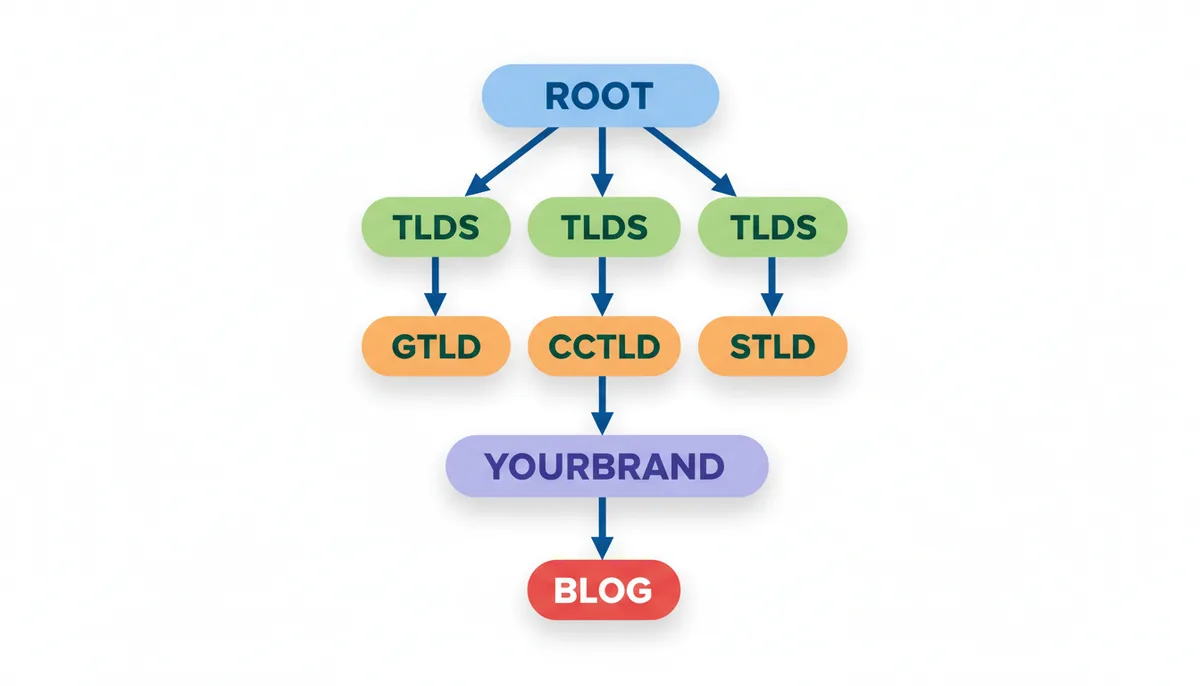
Domain extensions are officially categorized into three main types: generic TLDs (gTLDs), country-code TLDs (ccTLDs), and sponsored TLDs (sTLDs). Each category has its own characteristics and is managed by specific bodies to ensure consistency and reliability.
The Internet Corporation for Assigned Names and Numbers (ICANN) and the Internet Assigned Numbers Authority (IANA) are the key organizations responsible for managing and approving these extensions. They ensure that the domain system is not a free-for-all but a structured and secure environment for businesses and users alike.
It's important to note that while these categories are well-defined, there are blurred lines, especially with ccTLDs. Some country-code TLDs have become popular for general use, such as .io for tech startups or .co for companies. This repurposing has a significant impact on customer perception.
What Do the 'Classic Three' (.com, .org, .net) Signal to Users?
The .com, .org, and .net extensions are the most established and widely recognized TLDs. Each carries a distinct perception:
.com: Often seen as the gold standard for global and commercial entities, a .com domain implies credibility and establishment. It's what users type by default when they remember a brand name but not the full domain. For many businesses, securing a .com is a top priority.
.org: This TLD is strongly associated with non-profits, communities, and mission-driven organizations. If you're a for-profit business, using a .org can create a disconnect and potentially harm your brand's perceived legitimacy. Stick with .org if you're truly a non-profit or have a strong community focus.
.net: Originally intended for network and infrastructure-related businesses, .net's perception has become more diluted over time. It's seen as a common alternative to .com, often used when the .com is unavailable. While still respectable, it doesn't carry the same weight as .com and is generally a second-choice option.
Which Country-Code Extensions Now Have a Global Meaning?
Some country-code TLDs have gained new meanings beyond their original intent, appealing to a global audience. Here are a few examples:
- .io: Widely used by tech startups and software-as-a-service (SaaS) companies. It signals industry knowledge and a focus on innovation.
- .ai: Associated with artificial intelligence and tech companies. Using .ai can position your brand as cutting-edge and tech-savvy.
- .co: Recognized as a shorthand for 'company' or 'corporation'. It's a versatile option for businesses looking to project a modern and professional image.
- .tv: Commonly used by media and streaming platforms. A .tv domain can immediately communicate your focus on video content.
While these TLDs can signal industry expertise, they come with risks. Tech-literate customers will appreciate the savvy choice, but a broader audience might be confused or misremember the TLD as .com. Balancing these trade-offs is crucial.
| TLD | Original Country | Modern Perceived Meaning | Ideal Industry/Use Case | Potential Customer Confusion |
|---|---|---|---|---|
| .io | British Indian Ocean Territory | Tech, SaaS, Startups | Software Companies, Tech Innovators | Less tech-savvy users might misremember as .com |
| .ai | Anguilla | Artificial Intelligence, Tech | AI Companies, Tech Startups | General users may find it unfamiliar |
| .co | Colombia | Company, Corporation | Businesses, Startups | Users might type .com instead |
| .tv | Tuvalu | Video, Streaming | Media, Entertainment | Less known than .com, potential misremembering |
How Do Customers Perceive Newer, Industry-Specific TLDs?
Newer, industry-specific TLDs like .store, .app, .law, and .design offer a highly descriptive and immediate communication of a website's purpose. For example, a creative portfolio on a .design domain clearly signals the site's focus on design work. However, these TLDs come with their own set of challenges:
- Pros: They are highly descriptive and can immediately convey what your business does, making it easier for customers to understand and remember your domain.
- Cons: General awareness and trust are lower compared to .com. Some users may perceive these TLDs as less established, lower-budget, or even spammy. This can affect your brand's credibility and user trust.
To use these TLDs effectively, consider your target audience. A tech-savvy audience will appreciate the clarity and relevance of a .tech domain, while a broader, less specialized audience might be better served by a more mainstream TLD like .com or .co.
Examples:
- Positive: A design portfolio hosted on a portfolio.design domain clearly communicates the site's purpose and attracts the right audience.
- Negative: A large financial institution using a bank.money domain might come across as less established or trustworthy compared to a traditional bank.com.
Does Your Domain Extension Directly Impact SEO and Trust?
The choice of domain extension has a nuanced impact on SEO and trust. While it's a common belief that .com domains have an inherent advantage, the reality is more complex:
- SEO Impact: Google has stated that all generic TLDs are treated equally for ranking purposes. This means that a .com, .org, or .net domain is not inherently more favorable for SEO than a .store or .app.
- Geotargeting with ccTLDs: Country-code TLDs (.uk, .ca, etc.) are used by Google as a strong signal for geotargeting. If you're targeting a specific country, using the relevant ccTLD can help improve local SEO. However, this can also limit your reach in other regions.
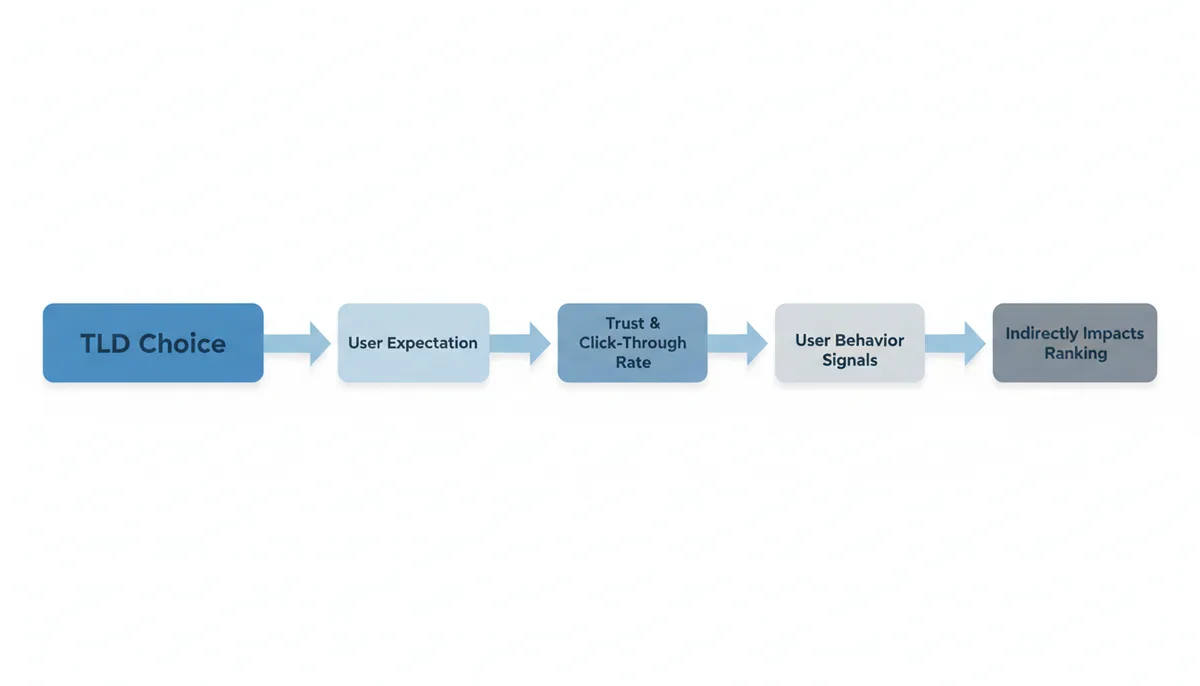
- Indirect SEO Impact: A trustworthy, memorable, and relevant TLD can improve user signals like click-through rate (CTR) from search engine results pages (SERPs). Positive user behavior, such as high CTR and low bounce rates, can indirectly impact your SEO rankings, but they are not a guaranteed ranking boost.
How Do You Choose the Right Extension When .com Is Taken?
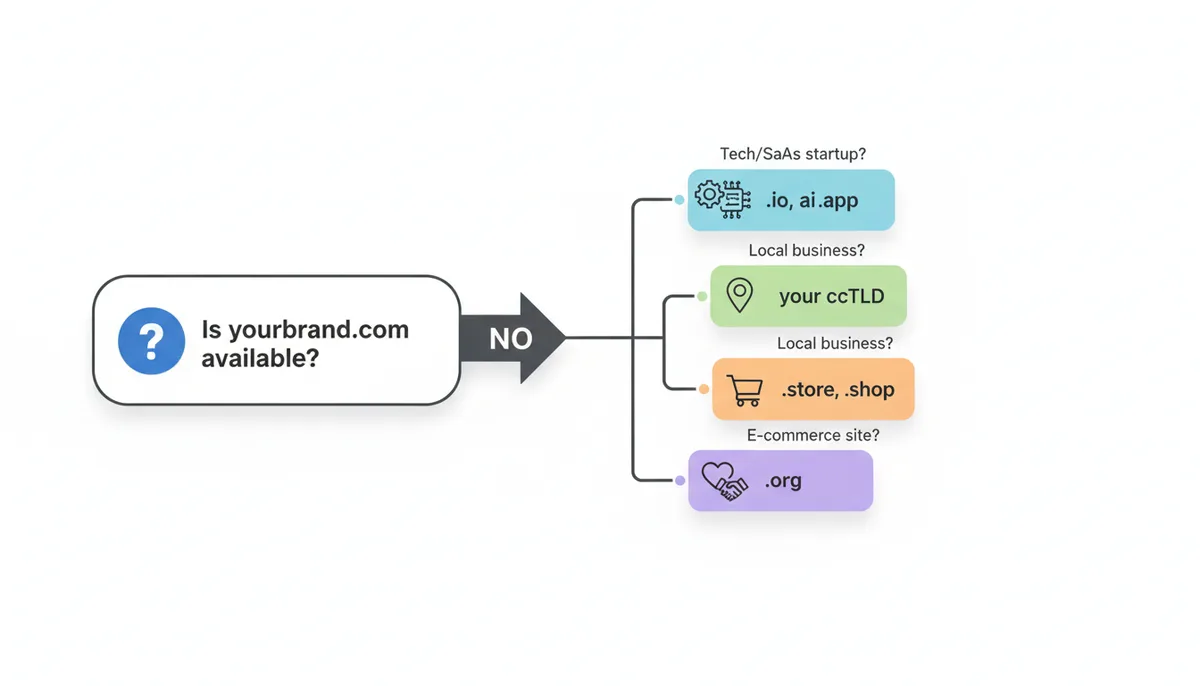
When the .com domain for your brand name is unavailable, don't settle for the first available option. Here's a framework to help you make an informed decision:
- First Alternative: Modify the domain name itself to get the .com. For example, if yourbrand.com is taken, consider yourbrandstore.com or getyourbrand.com. This approach often provides the best long-term benefits in terms of brand recognition and trust.
- If Modification Isn't an Option: Evaluate the next-best TLD based on your business model:
- Tech/SaaS Startup: Consider .io, .ai, or .app to signal your focus on innovation and technology.
- Local Business: Opt for your relevant ccTLD (e.g., .ca for Canada) to target your local audience effectively.
- E-commerce Site: Choose a descriptive TLD like .store or .shop to clearly communicate your business type.
- Non-profit: .org remains a strong option for mission-driven organizations.
What Are the Risks of Choosing a Trendy or Obscure TLD?
Selecting a trendy or obscure TLD can come with several risks:
- Domain Name Leakage: Users might forget the unusual TLD and default to typing .com, potentially sending traffic to a competitor or a dead page. This can dilute your brand's online presence and reduce your reach.
- Perception Risk: Some obscure TLDs are heavily used for spam and phishing activities. Associating your brand with one of these TLDs can damage your reputation and erode customer trust.
- Stability Concerns: TLDs tied to unstable countries or entities are at risk. Changes in registration rules or the discontinuation of a TLD could leave your domain vulnerable. Always research the stability and track record of a TLD before committing to it.
Which Extensions Require Verification and What Authority Do They Signal?
Sponsored or restricted TLDs (sTLDs) require proof of eligibility to register. These TLDs are often associated with high levels of trust and authority:
- .gov: Reserved for government entities, these domains require strict verification processes and signal a high degree of trust and authority.
- .edu: Intended for accredited post-secondary institutions, .edu domains also require verification and are seen as credible and authoritative.
- .bank: Exclusive to verified financial institutions, this TLD provides a strong signal of trust and security.
- .law or .cpa: Professional TLDs like .law for lawyers and .cpa for certified public accountants may have specific requirements, adding an extra layer of credibility to these domains.
Choosing a restricted TLD can significantly enhance your brand's trustworthiness, as these TLDs raise the barrier to registration and can signal verified eligibility.
| TLD | Intended Registrant | Verification Body/Process | Signal Sent to Customer |
|---|---|---|---|
| .gov | Government Entities | Verified by government bodies and ICANN | High trust, official information |
| .edu | Accredited Post-Secondary Institutions | Verified by educational accrediting bodies and ICANN | Credible, educational content |
| .bank | Verified Financial Institutions | Verified by financial regulatory bodies and ICANN | Secure, trustworthy financial services |
| .law | Lawyers and Legal Firms | Verified by legal accreditation bodies and ICANN | Professional, credible legal advice |
| .cpa | Certified Public Accountants | Verified by professional accounting bodies and ICANN | Trustworthy, expert financial services |
How to Use Domain Extensions for Local Business SEO and Trust
If you're running a local business, your choice of domain extension can significantly impact your SEO and customer trust. Unlike global businesses, local businesses often benefit from using country-code TLDs (ccTLDs) or even more specific regional TLDs. Here’s how you can leverage domain extensions to boost your local presence and credibility:
1. Choose the Right ccTLD
For a local business, using a relevant ccTLD can signal to both search engines and customers that your business is locally focused. For example, if you're based in the UK, using a .uk domain can help you rank better in local search results. Similarly, a .ca domain in Canada can provide a similar advantage. However, make sure to research the specific requirements and reputation of the ccTLD you choose:
- Research Residency Requirements: Some ccTLDs, like .ca, require proof of residency or a local presence. Ensure you meet these criteria before registering the domain.
- Check for Reputation Issues: Avoid ccTLDs that are associated with spam or low-quality content. A poorly perceived ccTLD can do more harm than good.
2. Enhance Local SEO with City or State TLDs
In addition to ccTLDs, you can also consider more specific regional TLDs to further enhance your local SEO. For instance, if you're based in New York City, you might consider using a .nyc domain. These TLDs are designed to target very specific geographic areas and can be highly effective for local businesses:
- TARGET LOCAL AUDIENCES: A .nyc domain clearly indicates that your business is in New York City, making it easier for local customers to find you.
- IMPROVE LOCAL IDENTITY: Using a city TLD can reinforce your local identity and build trust with your target audience.
3. Build Trust with Local Customers
A local domain extension can also build trust with your target audience. Customers are more likely to trust a business that uses a domain extension relevant to their location. For example, a local florist in London using a .london domain is more likely to be seen as a trusted, local business compared to one using a generic .com domain.
4. Concrete Example: Local Florist in London
Consider a local florist in London. Here’s how different domain extensions might impact their business:
- .com: While widely recognized, a .com domain might not clearly signal the local nature of the business. It could be seen as a generic online flower shop.
- .co.uk: A .co.uk domain clearly indicates that the florist is based in the UK, which can build trust with UK customers. However, it might not be as specific as a city TLD.
- .london: A .london domain reinforces the local identity of the florist. It signals to Londoners that the business is deeply rooted in their city, potentially increasing trust and local engagement.
By choosing the right domain extension, you can enhance your local presence, build trust, and attract the right audience without relying on unsupported SEO shortcuts.
The Role of Domain Extensions in Branding and Marketing
Your domain extension is more than just a technical address; it's a critical component of your brand identity and marketing strategy. The right domain extension can reinforce your brand message, attract your target audience, and distinguish you from competitors. Here’s how to leverage domain extensions for effective branding and marketing:
1. Align Your Domain with Your Brand Identity
Choose a domain extension that aligns with your brand’s values, mission, and target audience. For example, if you're a premium lifestyle brand, a .luxury domain might be more appropriate than a generic .com:
- RESEARCH YOUR AUDIENCE: Understand the preferences and perceptions of your target audience. What domain extensions do they trust and recognize?
- CONDUCT BRAND ASSESSMENT: Evaluate how different TLDs fit with your brand’s overall identity. Does a .tech domain reinforce your brand’s image as an innovative leader?
2. Use Descriptive TLDs for Clear Messaging
Descriptive TLDs like .store, .app, and .photography can immediately communicate your business’s purpose and attract the right audience. For example, a photography business on a .photography domain clearly signals its focus on photography services:
- IMPROVE USER EXPERIENCE: A descriptive domain makes it easier for users to understand what your site is about, improving their initial impression and engagement.
- DIFFERENTIATE FROM COMPETITORS: Using a descriptive TLD can help you stand out in a crowded market by clearly communicating your unique value proposition.
3. Leverage Domain Extensions for Marketing Campaigns
Domain extensions can be a powerful tool for marketing campaigns, especially when used creatively. For example, you might use a .sale domain for a special promotion or a .event domain for a specific event:
- CREATE TARGETED CAMPAIGNS: Use specific TLDs to create targeted marketing campaigns that resonate with your audience. For example, a .blackfriday domain for a Black Friday sale.
- BOOST ENGAGEMENT: Creative domain extensions can increase user engagement and encourage sharing, helping to spread the word about your campaigns.
4. Enhance Brand Recall with Memorable TLDs
A memorable domain extension can improve brand recall and make it easier for customers to remember and return to your site. Consider TLDs that are easy to remember and pronounce:
- USE SIMPLE AND DISTINCTIVE TLDs: Avoid complex or obscure TLDs that might confuse users. A .io domain is more memorable than a .biz domain.
- REPEATABLE BRAND MESSAGE: Ensure that your domain extension reinforces your brand message consistently across all marketing channels.
5. Monitor Brand Perception and Adjust
Regularly monitor how your domain extension is perceived by your audience and make adjustments as needed:
- COLLECT FEEDBACK: Gather feedback from your customers and stakeholders to understand how your domain is perceived.
- CONDUCT A/B TESTING: Test different domain extensions to see which one performs best in terms of engagement, conversions, and overall brand perception.
Common Pitfalls and How to Avoid Them
Choosing the wrong TLD can create perception trade-offs. Use this focused checklist to weigh the practical risks and the small, specific actions that address them:
- Memorability leakage: Users default to .com and may mistype less common TLDs. Action: If you keep a non-.com primary, consider registering the .com (or a close match) defensively and redirecting it.
- Trust risk: Some TLDs carry associations with low-quality or malicious sites. Action: Check the TLD's reputation in your industry and choose restricted or well-known TLDs when trust is critical (finance, healthcare).
- Restricted eligibility: sTLDs and some ccTLDs require verification or residency. Action: Confirm eligibility and verification steps before committing; factor verification time into your launch plan.
- Price and renewal surprises: New or premium TLDs can have high first-year and renewal fees. Action: Review registration and renewal pricing up front and budget for multi-year registration if needed.
- Defensive registration: Competitors or bad actors can register similar domains and dilute your brand. Action: Prioritise registering core defensive variants (common typos, major TLDs, local ccTLDs) based on where your customers search and type.
Cost and Effort Considerations for Domain Extensions
The cost and effort required to register and manage different domain extensions can vary significantly. Understanding these factors can help you make an informed decision that fits your budget and resources:
1. Registration Costs
TLDs can vary widely in registration costs, and some premium TLDs can be significantly more expensive than common TLDs like .com. Here’s how to navigate these costs:
- CHECK PRICING: Research the registration costs of the TLDs you’re considering. Some TLDs, especially new or niche ones, can be more expensive due to higher wholesale costs or market demand.
- BUDGET ACCORDINGLY: Set a budget for domain registration and be prepared to adjust it based on the TLDs you choose. Consider the long-term value of a more expensive TLD if it aligns better with your brand and goals.
2. Renewal and Renewal Policies
The cost and process of renewing a domain can also vary. Some TLDs have strict renewal policies that can be more cumbersome or expensive:
- RESEARCH RENEWAL POLICIES: Check the renewal policies of the TLDs you’re considering. Some may require automatic renewals or have higher renewal fees.
- SET REMINDERS: Use domain management tools to set reminders for domain renewals to avoid accidental expiration and the potential loss of your domain.
3. Domain Management and Maintenance
Managing multiple domain extensions can require additional effort and resources. Consider the administrative burden of managing multiple domains:
- USE DOMAIN MANAGEMENT TOOLS: Utilize domain management tools and services to streamline the process of managing multiple domains. These tools can help you keep track of registration dates, renewals, and other important details.
- OUTSOURCE IF NECESSARY: If managing multiple domains becomes too time-consuming, consider outsourcing to a domain management service or a digital agency with expertise in domain management.
4. SEO and Marketing Integration
Integrating your domain strategy with your overall SEO and marketing efforts can add to the cost and complexity. Ensure that your domain choice aligns with your broader marketing goals:
- ALIGN WITH SEO STRATEGIES: Ensure that your domain choice supports your SEO efforts. For example, using a relevant TLD can improve local SEO and help you rank higher in search results.
- BUDGET FOR MARKETING: Allocate resources for marketing and promoting your domain. A well-branded TLD can help attract more visitors, but it requires ongoing marketing efforts to build awareness and drive traffic.
5. Legal and Compliance Considerations
Some TLDs, especially restricted TLDs like .gov and .edu, have strict verification and compliance requirements. These can add additional costs and effort to the registration process:
- CHECK VERIFICATION REQUIREMENTS: Research the verification requirements for any restricted TLDs you’re considering. Ensure you meet all the necessary criteria to avoid delays or rejections.
- CONSULT LEGAL EXPERTS: If you're unsure about the legal and compliance requirements of a specific TLD, consult with legal experts or domain registration professionals to ensure you’re in compliance.
By carefully considering the costs and effort involved in managing different domain extensions, you can make a well-informed decision that aligns with your budget and long-term business goals. Whether you choose a traditional TLD like .com or a more specific TLD, ensure that your domain strategy supports your overall brand and marketing efforts.
FAQ
Should I buy my brand name on multiple domain extensions?
Yes, it's a good defensive strategy. Owning the .com, .org, and your local ccTLD prevents competitors or bad actors from registering them. You can redirect the extra domains to your primary site to consolidate your online presence.
Will having a non-.com extension hurt my business forever?
Not necessarily. While .com is the default for many, a well-branded and relevant TLD (like .io for a tech company) can perform very well. The key is to build a strong brand so customers remember your full domain and trust your business.
Can I change my domain extension later?
You cannot 'change' an extension. You must register a new domain with the new extension and then permanently redirect (using 301 redirects) your old site to the new one. This is a complex process with significant SEO implications, so it's best to choose the right TLD from the start.
Are country-code extensions only for businesses in that country?
It depends on the TLD. Some, like Canada's .ca, have residency requirements. Others, like Colombia's .co or Tuvalu's .tv, are unrestricted and can be registered by anyone globally. Research the specific requirements for the TLD you're considering.
Why do some extensions cost so much more than others?
Pricing is set by the registry that operates the TLD. Newer, more specific, or 'premium' TLDs like .auto or .game often have higher wholesale costs than common TLDs like .com, resulting in a higher price for you. Premium TLDs also often come with additional features or services.
Can a customer's location change the TLD they see?
No, the TLD is fixed. However, large international companies often own multiple ccTLDs (e.g., google.de, google.fr) and automatically redirect users to the version that matches their geographic location for a localized experience. This helps improve user engagement and trust.
By understanding the psychological signals your domain extension sends, you can make an informed decision that aligns with your brand's goals and values. Whether you opt for the established trust of a .com or the descriptive clarity of a newer TLD, the key is to choose a domain that resonates with your target audience and supports your business's long-term success.
Sources
- ICANN — Definitions and governance of TLD types (gTLD, ccTLD, sTLD)
- IANA Root Zone Database — Authoritative list of all valid top-level domains
- Google Search Central — Guidance on how gTLDs and ccTLDs are treated for search and geotargeting
- Nielsen Norman Group — Research on user trust, cognitive fluency, and brand recall online