What SEO Insights Matter When Choosing a Domain Name
Last year a founder brought me two domain shortlists for the same plumbing-supply business. One list was full of phrases like best-pipe-fittings-online and pipe-fittings-deals. The other had three short, made-up names. She asked which list would rank better. The honest answer was that neither list would rank because of its domain alone. The name would matter for a few specific reasons, and most of those reasons had nothing to do with the words in it. This article walks through which domain name SEO factors actually move the needle, which ones are leftovers from a decade ago, and how to make a choice you won't regret in three years.
Does Your Domain Name Still Need a Keyword?
Not in the way it used to. For a long stretch of search history, owning a domain that exactly matched a search phrase was a real advantage. If you owned cheap-flights-to-rome.com, you had a head start on anyone searching for that phrase. The domain itself carried a lot of the relevance signal, and many people built thin sites on these names because the shortcut worked.
Google changed that with what became known as the Exact Match Domain update, rolled out in 2012. It was aimed at low-quality sites that ranked mainly because their domain contained the query. After that update, a keyword in the domain stopped being a dependable way to win. Exact match domains (EMDs) still exist, and some still rank, but the ranking usually comes from the content and links behind them, not from the words in the name.
Compare the two kinds of signal. A keyword in your domain is a small, short-lived relevance hint. It tells a search engine what the site is about, and it tells a searcher the same thing before they click. That is useful, but the search engine can learn the topic from your titles, headings, and page text within weeks of publishing. Once it has done that, the keyword in your domain adds little.
A unique, memorable, brandable name works on a different timescale. It accumulates value every time someone types it, remembers it, recommends it, or clicks it in a results page. A person who has heard your name on a podcast, sees it in a results list, and recognises it as the site they used last month is more likely to click. That behaviour feeds back into how search engines judge your site, and it keeps working when you change topics, add products, or rebuild the site.
So here is my rule. Put a keyword in your domain only when it comes free with a name that is also short, pronounceable, and clearly yours. Do not trade brandability for a keyword. The trade costs you more later than the keyword ever gives you now.
The purpose of the domain, for modern SEO, is to build a brand that people recognise and choose in search results. That is the job. Everything else is secondary.
How Do Search Engines Actually 'Read' a Domain Name?
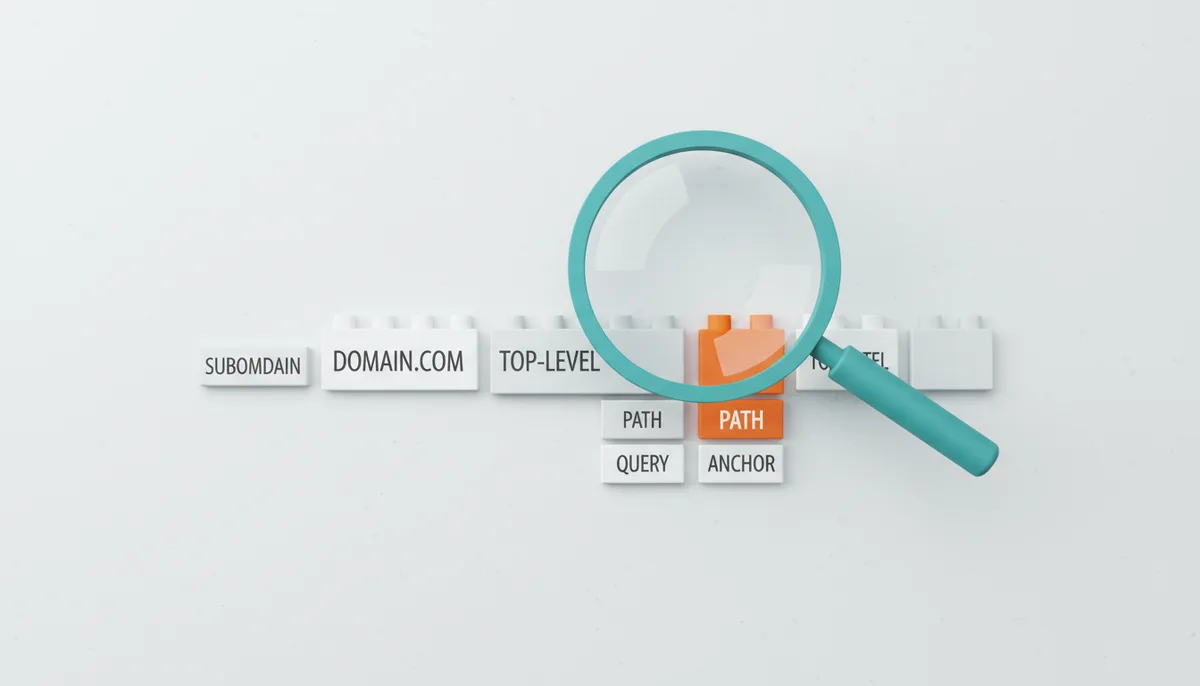
A domain name is made of parts, and each part is read differently. Take the address blog.pipesupplyco.com. A search engine sees three pieces.
The first piece on the right is the top-level domain (TLD), which here is .com. The TLD is the last label in the address. Generic TLDs (gTLDs) like .com, .org, .net, and newer ones like .shop or .app are open to anyone who meets the registry's rules. Country-code TLDs (ccTLDs) like .co.uk or .de are tied to a country. I cover how these affect SEO in their own section below.
The second piece is the root domain string, which is pipesupplyco. This is the part you choose. It is what the registry actually sold you, and it is the thing that links to everything under it.
The third piece is the subdomain, which is blog. Subdomains sit to the left of the root domain and are often used to separate parts of a site. Whether a search engine treats a subdomain as part of the main site or as something separate is a question with a messy answer, and I return to it in the subdomain section.
Now the important part: search engines do not rank a domain name the way they rank a page's content. Almost all the ranking work happens at the page level, using the content, the links pointing to the page, and many other signals. The domain name's influence is mostly indirect. It shapes how people respond to your site, and some of that response may feed into signals search engines use, though nobody outside the company knows which ones or how much weight they carry.
Consider click-through rate (CTR), meaning the share of people who see your result and click it. A clear, trustworthy name can reasonably be expected to earn more clicks than a name that looks like a spam farm. If two results sit side by side and one is pipesupplyco.com while the other is cheap-pipe-fittings-deals-2024.net, most people will pick the first. That is a pattern in how people behave, and it is the part you can actually control. What you can't do is treat it as a known ranking formula. Google has never published one that connects clicks to positions or says "name X gets Y more clicks means Z ranking," and it has been cautious about describing click data as a direct ranking input. So use CTR as a reason to pick a credible name, not as a number to plan a ranking around.
This connects to E-E-A-T, the framework from Google's quality rater guidelines. The letters stand for Experience, Expertise, Authoritativeness, and Trustworthiness. Those guidelines are written for human raters, not as a ranking algorithm, but they describe what a good search system is trying to reward. A domain that looks professional, is easy to type, and matches the business it represents is a small piece of evidence for trustworthiness. It doesn't prove anything. It removes a reason for doubt. A domain full of hyphens, odd suffixes, and stacked keywords creates doubt before anyone reads a word.
The mechanism matters because it tells you where to spend effort. Don't try to game the parsing of your domain. Pick a name that makes people more willing to click and more willing to trust what they find after they click.
Evaluating a Brand-New Domain for SEO Potential
Start with a shortlist of four tests. A good new name is short, easy to spell, easy to say out loud, and unique. Each test catches a different failure.
Short. Length matters, though not as a ranking factor. There is no evidence that a shorter domain ranks better by itself. Length matters because short names are easier to remember, type, and fit on a business card or into an ad. A name of around eight to twelve characters before the TLD is a comfortable range for most businesses. Under about eight, you are competing with a lot of names that have already been taken. Over around fifteen, people start to mistype it or drop a word when they repeat it to someone.
Easy to spell. Say the name to someone who has never seen it, then ask them to type it. If they write it differently, you have a problem. Spelling trouble shows up in the wild as typos that land on someone else's site, lost traffic, and branded searches that return the wrong results. Invented spellings like "lyft" or "tumblr" worked for some famous companies, but those companies had enormous marketing budgets to make the spelling stick. You probably don't.
Easy to pronounce. Test it over the phone in your head. Would a person hearing it on a podcast know how to write it? If the name has two plausible spellings, or sounds different depending on which word you emphasise, it will leak traffic.
Unique. This is where most new businesses get it wrong. Common words make for crowded namespaces. Many dictionary words are already attached to established brands in your category, and even when the exact .com is free, the brand around that word may already exist. Unique names are harder to find, but they give you something to build on.
Once a name passes those four tests, check for brand confusion. Search the name in quotes on a search engine, and search it on social platforms. Look at what shows up. If a company with a similar name already dominates the first page, your users will be confused, and your brand search traffic will be contaminated by theirs. Confusion is a bigger problem than people expect, because it wastes the clicks you earn. A user who types your name and lands on a competitor's site doesn't come back to you. They assume you are the competitor, or that your site is a scam.
Then run a trademark search. Most national trademark offices, including the USPTO in the United States, let you search registered marks for free. Look for identical or confusingly similar marks in your category. A trademark problem can cost you the domain itself through a dispute process, and it can force a rebrand after you have spent money on it. A search doesn't replace a lawyer for a serious business, but it catches the obvious conflicts before you commit.
Finally, ask whether the name is future-proof. This is the test people skip. If you name your business PipeSupplyCo and then want to sell heating equipment, or sell to commercial clients instead of homeowners, the name either holds or it gets in the way. A name tied to a specific product or city binds you to that niche. A name that describes a feeling, a process, or nothing in particular gives you room to pivot. Plenty of companies with very literal names have spent years and money re-branding to escape them.
The trade-off is real. A flexible name is harder to fit with a keyword and usually means you give up a little immediate relevance. I accept that trade for almost every business that plans to exist for more than a year or two, because the cost of a bad name grows as the business grows.
How to Vet an Expired or Aged Domain's SEO History
Buying an expired domain is tempting because it looks like a shortcut. The domain already has years of history, possibly backlinks, and sometimes a fancy-looking authority score. The shortcut only works if the history is clean, and most of the time the history is what you are actually buying. That's why you need to vet it.
Here is the process I use, in order. Each step can end the evaluation, and each one is cheap compared with the cost of a bad purchase.
Step 1: Establish what the domain was. Use the Wayback Machine. Enter the domain and look at snapshots across several years, not just the most recent one. Pay attention to the content, the design, and the topic. Note the years when the site changed, and note any gaps. A domain that was a real site for six years and then went quiet is a different case from one that changed hands every few months.
Step 2: Look for spam and low-quality content. In the snapshots, check for signs of automated or manipulative use. These include pages stuffed with keywords, hundreds of near-identical articles, scraped content, auto-generated product lists, and footers linking to unrelated sites. If the domain was used for a casino, a payday loan site, or a "best supplements" page after a long life as a pet blog, the subject matter pivot is a red flag. Pivots aren't always spam, but a sudden change into a high-risk category usually means the new owner was trying to rank something, not build something.
Step 3: Check the DNS and hosting history where you can. The domain's DNS records (the settings that tell the internet where to find its website and email) can show whether it pointed to shared spam hosting, a known link farm, or a pile of unrelated domains. Historical DNS data is available through some paid tools, and it is worth paying for when a domain looks suspicious. Even without that, a WHOIS lookup shows the registration history, status, and whether the domain was recently transferred or re-registered. Expect the owner information to be private or redacted in many cases, and don't treat that alone as a warning.
Step 4: Analyse the backlink profile. This is where most of the value and most of the danger sits. Tools like Ahrefs, Majestic, and Moz each crawl the web and report which sites link to the domain. You are looking for three things. First, quality: are the linking sites real, active, and reasonably respected in their field? Second, topical relevance: do the sites linking to a former pet blog come from pet-related sites, or from a random assortment of directories and casino pages? Third, signs of manipulation: a flood of links from sites that all look identical, link to each other in clusters, or share the same owner is typical of a private blog network (PBN), a set of sites built only to pass link value.
The metrics these tools report are useful, but they are estimates built from their own crawls. Ahrefs' Domain Rating (DR) and Moz's Domain Authority (DA) try to summarise how strong a domain's link profile looks. Majestic's Trust Flow and Citation Flow do something similar with a different method. Moz also offers a Spam Score. None of them are Google metrics. None of them tell you what Google thinks of the domain. Treat them as a warning light, not a verdict, and never as a price tag.
Step 5: Review the anchor text distribution. Anchor text is the clickable words in a link. When many links to a domain use the same commercial phrase as their anchor, such as "cheap payday loans" thousands of times, that pattern is a common sign of manipulation. Natural anchor text is mixed. It includes the brand name, the URL itself, generic phrases like "this guide," and occasional descriptive terms. If the anchor text is dominated by one money phrase that has nothing to do with the site's former topic, the links were probably bought for that phrase.
Step 6: Check for a manual action before you buy. You can't check Google Search Console for a domain you don't own, because Search Console requires verified ownership. So you check what you can before purchase, and then verify the domain in Search Console immediately after you buy it. Its Manual Actions report tells you whether Google has applied a manual penalty to the site. Its Links report shows the links Google has found. If you find a manual action after buying, you may need to fix the problem and submit a reconsideration request, and you may also use the Disavow tool to tell Google to ignore specific links. Disavow is a last resort. Use it only when you have clear evidence of manipulative links you cannot get removed.
The figure below shows the decision logic I use for this process. The first gate is spam history, the second is backlink toxicity, and the third is anchor text.
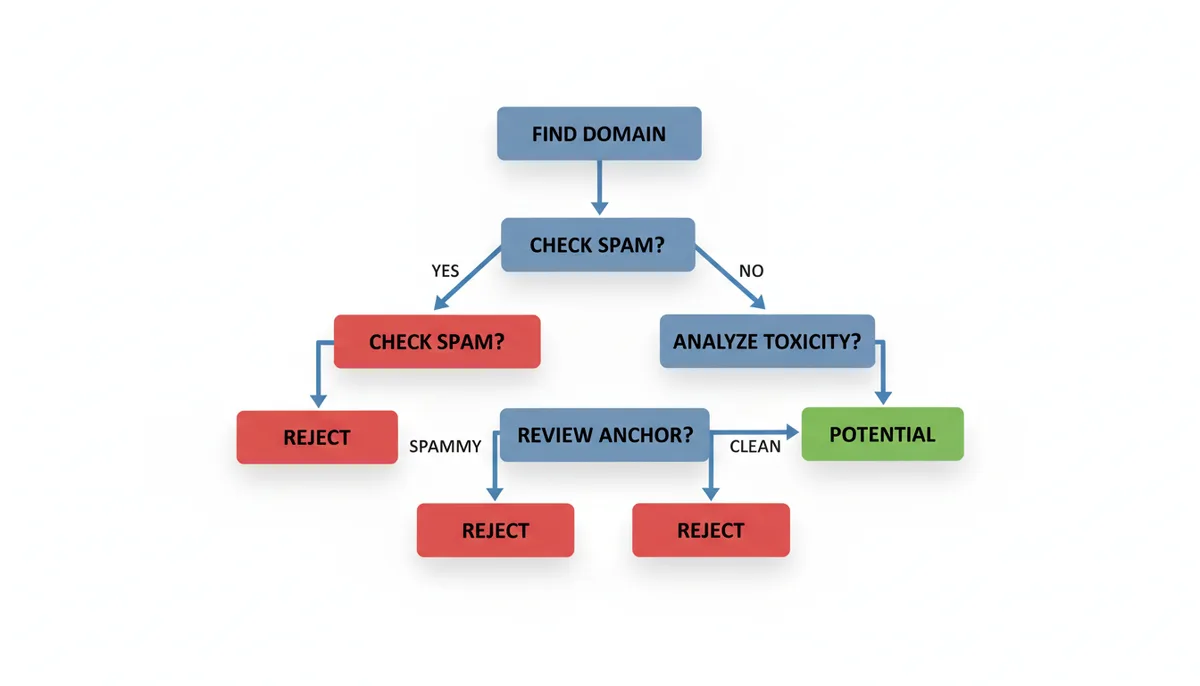
A "Potential Candidate" is not a purchase decision. It means the domain passed the gates that can kill it. Before you pay, confirm that the topic you plan for the site fits the domain's past, which I cover in the FAQ below. A clean history on a topic you don't intend to cover is worth very little.
One mistake I see often: people run these checks, see a few suspicious links, and decide the domain is fine because the total number of links looks impressive. The number is the wrong thing to look at. Ten links from a single network of spam sites can do more damage than a hundred ordinary links from real sites. Look at the sources, not the count.
Branded vs. Keyword-Rich: Which Domain Type Is Right for You?
Most domains fall into one of three types. A branded domain is a made-up or distinctive name with no obvious keyword in it, such as Zillow. A partial match domain (PMD) includes a keyword alongside a brand or location term, such as seattlerealestate.com. An exact match domain (EMD) is the full keyword phrase, such as realestateinseattle.com.
The three types differ in what they promise. A branded domain promises nothing about the topic, so it has to earn recognition. A partial match domain promises a topic and a place or specialism, which gives people a reason to click before they know you. An exact match domain promises the whole search phrase, which gives a small immediate advantage and the most risk of looking spammy.
Here is how the three compare on the attributes that matter most for a long-term project.
| Attribute | Branded Domain | Partial Match Domain | Exact Match Domain |
|---|---|---|---|
| Long-Term Brandability | High: works across products, markets, and topics | Medium: the keyword ties the name to one niche or place | Low: the name is the phrase, so it rarely survives a pivot |
| Initial SEO Signal | Weak: relevance comes from content and links only | Moderate: a topic hint that appears in the URL and in search results | Strongest at launch, but the advantage has shrunk since the 2012 update |
| User Trust and Memorability | High once known: easy to recall and type | Medium: clear what the site covers, but often mistaken for a directory | Low to medium: often reads as generic or spammy, and is easy to mistype |
| Risk of Penalty | Lowest: no keyword pattern to trigger quality filters | Low to medium: depends on whether the site is thin or duplicated | Highest: the 2012 update targeted sites like this, and many were demoted |
| Best Use Case | A business that expects to grow, expand, or rebrand over many years | A hyper-local service or a narrow niche where the place or specialism is the product | A short-term affiliate or test project with a low budget and a limited lifespan |
My default recommendation is a branded domain for any business that wants a destination site, meaning a place people return to for a product, a service, or a body of trusted content. The branded name lets the business grow sideways without rewriting its identity. It also gives you the safest position if search systems change their approach again, because you aren't relying on a keyword pattern that the systems have spent over a decade learning to discount.
Partial match domains have a narrow but real place. A plumber in one city has a good case for a name like portlandplumbingco.com, because the place and the trade are the business. The user intent is specific, the market is local, and the domain tells a homeowner in Portland exactly what they're getting. The trade-off is that the name is locked to Portland and to plumbing. If the plumber later adds heating services or moves across the river, the name starts to fight them.
Niche affiliate sites can also use partial match names when the niche is tight enough that users search for the exact phrase and the site is built to answer that search. Even then, I'd expect the site to rely on its content and reputation within a year, and I'd be ready to move it to a brand name if it becomes a serious business.
Exact match domains are the riskiest choice for anything you plan to keep. Use one only when the project is short-lived by design, the budget is small, and you accept that the name may stop working when the algorithms or the niche shift.
How Your TLD Choice (.com, .org, .shop) Impacts SEO
Google has said for years that generic TLDs don't get a ranking advantage over one another. A .com and a .shop are both treated as ordinary domains in the ranking system. If your question is whether Google will rank .shop lower than .com on its own, the honest answer is that it shouldn't, and it doesn't do so in any way you can measure. The TLD isn't the thing that decides your ranking.
But the question "does TLD affect SEO" is really asking about users, and users are not neutral. People expect a business to be on .com. When someone types your brand name into a browser, the reflex is to add .com. If your business is on .shop, a meaningful share of those people will land on a different .com, or on nothing at all. Google can't see that loss, but your analytics will. That is the cost you're accepting.
The honest rule is this. Choose .com for global or US-based commercial sites unless you have a strong reason not to. It's the default people expect, it's the easiest to remember, and it's the most available for good names. Choose .org for nonprofits and community projects where the audience already expects it. Choose .net only if you have a specific reason, because most people don't reach for it first.
Country-code TLDs are different, and here the TLD matters for SEO in a real way. A ccTLD like .co.uk or .de is tied to a country, and search engines treat it as a strong signal of which audience the site is for. If you run a store that ships only within Germany and most of your customers are German, a .de domain helps Google understand the geographic target. For that case, a ccTLD is hard to beat for geotargeting.
The trade-off is that ccTLDs limit your reach. A .de site is harder to market in the United States, harder to position as global, and sometimes harder to keep in line with your brand if you expand. If you might grow outside that country, a .com with country-specific subfolders (such as example.com/de/) usually works better, which I explain in the subdomain section.
Generic TLDs like .app, .law, or .shop can offer topical context. A .law domain tells a visitor you are in the legal field before they read anything, and a .app domain tells them you probably sell software. That context can help with click-through, especially in a crowded results page. The cost is recognition. A .shop domain has less built-in trust than a .com, and some users will not automatically believe a .shop site is a real business. Many people also hesitate to type unfamiliar TLDs or assume they are pointing to a scam.
So if you pick a gTLD for topical context, do it knowingly. Check whether the .com is available and what it would cost. If the .com is held by a dormant parking page, a sensible offer through a broker may be cheaper than a year of explaining your unusual TLD to customers. If the .com is held by an active business in your field, the gTLD may be your best option, but plan for the trust gap with stronger brand signals elsewhere.
Subdomains vs. Subfolders: Structuring Your Site for SEO
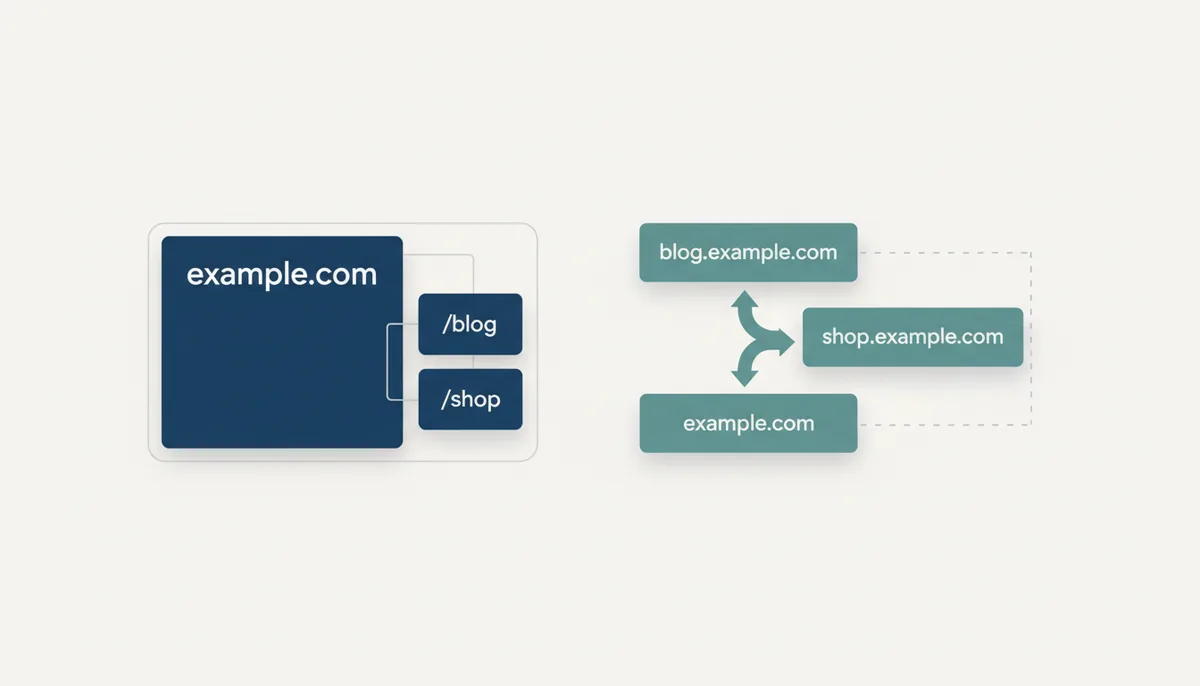
This is the decision most people make without noticing, and it changes how authority flows through your site. A subfolder is a path after your root domain, such as example.com/blog. A subdomain is a prefix before it, such as blog.example.com. Both can host the same content. They behave differently in how search engines treat the pages.
Google has said it can treat a subdomain either as part of the main site or as a separate one, depending on the signals it sees. In practice, the more separated a section is, the less the ranking signals from your main site carry over to it, and the less the section's signals help the main site. A subfolder keeps everything under the same root domain, so links, content quality, and reputation consolidate. A subdomain splits them into what is effectively a separate project in the search engine's eyes, even though it shares your brand.
Here is a concrete case. Imagine a company with a strong main site at example.com that earns good links for its product pages. It launches a blog. If the blog is at example.com/blog, every good article adds to the reputation of the whole domain, and links to the blog lift the main site too. If the blog is at blog.example.com, the same articles build a separate reputation, and the company has to earn links for that reputation from scratch. Some of the value still flows, but less of it, and it takes longer.
The prevailing best practice, and what I'd recommend for most businesses, is to use subfolders. Put your blog, your shop, your help centre, and your regional pages under one root domain unless a specific reason forces you to split them. You consolidate authority, you avoid duplicated setup costs for each section, and you keep one set of analytics and one Search Console property to manage. The downside is that a subfolder shares the root's technical setup, so a bad change to the main site can affect the blog too. That risk is manageable. The alternative is usually harder.
There are valid reasons to use a subdomain, and they're worth listing precisely:
- Completely separate product lines. If you run a bank that also operates a separate investment platform with its own brand, login system, and legal entity, a subdomain may keep the two clearly apart.
- International sites on different platforms. If your French site runs on a different technology stack from your main site, a subdomain such as fr.example.com can make that practical. Use hreflang annotations to tell search engines which language or region each version targets, regardless of whether the versions are on subdomains, subfolders, or ccTLDs.
- User-generated content. Platforms that host member pages, such as a forum or a marketplace of sellers, often use subdomains so that user content is isolated. This keeps low-quality or spammy user pages from dragging down the main site, though it also means their links don't help the main site as much.
Notice what those cases have in common. Each one has a practical or legal reason to keep the section separate. "We want it to look organised" is not a reason. Neither is "the developer set it up that way and we don't want to change it," although that one is more common than people admit.
Migrating from a subdomain to a subfolder is possible, but it is work. You'll need 301 redirects from every old URL to its new home, an updated sitemap, updated internal links, and monitoring in Search Console for a few months while the signals move. Plan for that cost before you choose the subdomain, not after.
The diagram below shows the difference in how authority is held. The left structure keeps everything in one place. The right structure divides it.
Common Domain SEO Myths That Waste Your Time
Some of the advice around domain names is wrong in ways that cost real money. Four myths come up often enough to deserve specific answers. The table after them sets out the myth and the reality side by side.
The first myth is that a high Domain Authority or Domain Rating on an expired domain is a silver bullet. Those scores come from third-party tools. They estimate link strength using each tool's own crawl and its own formula. They are not Google's measure, and they can be inflated by links that Google discounts or penalises. A domain can show a strong score because it has thousands of links from a private blog network, and that score will look just as impressive in the tool as a clean one. Worse, the score says nothing about why the links exist. Before you spend money on a high DR domain, you need the history, the anchor text, and the topical fit. The number is a reason to look closer, not a reason to buy.
Here is a real consequence. A buyer chooses a domain for its high DR, then builds a site on an unrelated topic. The site ranks poorly, and the buyer assumes the domain is just weak. The actual problem is that the links were attached to a topic the site no longer covers, and the anchor text points to services the site doesn't offer. The authority is there on paper and does almost nothing for the new business.
The second myth is that hyphens are an absolute SEO killer. They aren't. Google parses hyphens as word separators, so a domain like best-running-shoes.com is read as separate words. There's no direct penalty for using one. The reason to avoid hyphens is practical. People mishear them, forget them, and type domains without them, which sends traffic to the wrong place. Hyphenated names also tend to look like the names spammers use, which affects trust. Avoid them for your brand. Don't avoid them because you think a crawler will punish you for the character.
The third myth is that you need to buy every TLD variation of your domain to rank. You don't. Buying example.net, example.org, and example.shop is a defensive branding move. It stops competitors and typo-squatters from taking your name in other extensions, and it can be worth the cost for a valuable brand. It isn't a ranking factor. Google doesn't reward owning variations, and having them doesn't lift your main site. If you do own several variants and they show the same content, use a canonical tag on the variants so search engines know which version to index, or redirect them with 301s to the main site. The canonical tag is a hint that tells search engines which version of a page is the preferred one. The technical side is simple. The question is whether the spend is worth it for brand protection.
The fourth myth is that an older registration makes a domain rank better. The idea is popular because it sounds plausible. Search engines do see a registration date somewhere in the domain's public data, so it seems like a reasonable signal. John Mueller at Google has said repeatedly that registration age is not a ranking factor. The practical cost shows up when buyers pay a premium for a domain that has been registered for fifteen years but has never hosted anything. They've bought a number on a certificate, not a history. If an old domain is worth something, it's because of what was built on it and who linked to that work, and you can only judge that by checking the content and the backlinks.
| The Myth | The Reality |
|---|---|
| A high DA or DR on an expired domain guarantees faster rankings. | DA and DR are third-party estimates that can be inflated by manipulated links. Without a clean history, anchor text that fits your topic, and a relevant backlink profile, a high score does not guarantee faster rankings for your site. |
| Hyphens will destroy your rankings. | Google treats hyphens as word separators and applies no direct penalty for them. However, hyphens reduce memorability and increase the chance of typing errors, and they can make a brand look spammy, so avoid them for branding reasons. |
| You must buy every TLD variation to rank. | Owning TLD variants is a defensive branding decision and is not a ranking factor. If you do buy variants, point them to your main site with 301 redirects or use canonical tags to indicate the preferred version to search engines. |
| Google can see the registration age and rewards older domains. | Registration age by itself is not a ranking factor. What matters is the site's history—its content and backlinks—not how long the domain has been registered. |
Frequently Asked Questions
I found a great domain but the .com is taken. Should I just add a hyphen or a word like 'hq'?
Usually no. Adding a hyphen or a filler word like "hq," "app," or "online" makes the name harder to remember, harder to type, and more likely to look like a copy of the original. You'll spend years correcting people who type the .com by reflex and land on the other business. The cost of that friction is larger than the value of the exact phrase.
Go back to the naming process and find a new, unique name that passes the four tests from the evaluation section. That will almost always serve you better. If the original phrase is essential to your brand, a rare exception, consider a broker or a direct approach to the owner first. Check whether the owner is actively using the domain, because a parked or dormant .com is sometimes available for a reasonable price. Only use a hyphen or filler word when you have no other option and you are prepared to live with the trade-off.
How long does it take for a new domain to start ranking on Google?
It can take anywhere from a few weeks to several months, and the spread depends on a lot of things. Google has to discover the site, crawl its pages, index them, and gradually decide how much to trust it. A site with no links and thin content may take longer. A site that earns some links early, gets indexed quickly, and answers a specific question clearly can start appearing for narrow queries sooner.
Don't wait for a ranking to start improving the site. Publish high-quality content consistently from the start, submit a sitemap in Google Search Console, make sure pages are indexable, and fix technical problems as you find them. A new domain that looks busy and useful gets crawled more regularly than one that sits empty. Expect a slow start, and judge progress by indexing and impressions in Search Console, not by a single keyword position.
Is it worth paying thousands for a 'premium' domain name?
It can be, but only in a narrow set of cases. A premium name is one that is exceptionally short, memorable, and highly brandable, and that fits your business closely enough that you'd want it even at a high price. If you're building a business that could grow into a large brand, a name like that can be a sound investment, because it removes a long-term obstacle and makes marketing easier.
For most new ventures, though, a creative, available name is the better use of money. Spend the budget on the product, the content, and the first year of marketing. A premium price for a name your customers will still need to learn is a poor trade if the business doesn't survive its first two years. Set a budget before you start looking, and be willing to walk away.
If I buy an expired domain, do I have to use its old topic?
For the best results, yes, or at least something very close. The reason is that the domain's value comes mainly from the links pointing to it and the relevance those links carry. A pet blog that earned links from pet sites has relevance in the pet field. If you build a casino site on it, those links now look like they were bought for the wrong purpose, and they add little to your new topic while carrying the risk of looking manipulative.
If you do pivot, do it carefully. Make sure the new topic is clearly connected to the old one, rebuild the content from scratch, and monitor the backlink profile. Expect the inherited authority to shrink over time, and don't assume the domain's history will carry a new business. A pivot to a completely unrelated topic usually devalues the history, and sometimes leaves you with a site that is hard to rank at all.
Does the registrar I choose (e.g., GoDaddy, Namecheap) affect my SEO?
No. Your registrar has no direct effect on how Google ranks your site. The registrar is the company you pay to hold the domain registration, and it is accredited through ICANN's system. It doesn't feed into ranking signals.
Choose a registrar for the things that actually affect you: price for renewals (not just the first year, which is often discounted), the strength of account security options such as two-factor authentication, how easily you can transfer the domain, how clear the DNS management tools are, and how responsive support is when something breaks. A registrar that makes it hard to change DNS or that locks you in with high transfer fees will cost you far more than any SEO effect would.
Will having an old domain (high registration age) help my SEO?
No. Google's John Mueller has said repeatedly that domain registration age is not a ranking factor. How long a domain has been registered doesn't move your rankings on its own. A domain registered ten years ago and never used is no more valuable than one registered last week.
What does matter is the history of what was on the domain, and the links that point to it. A domain that was a real, respected site for many years may carry trust and relevance that help it, but that comes from the site's history, not from the registration date. When you evaluate an old domain, look at the content and the links, not the year it was first registered.
Conclusion
If you take one thing from this, make it the order of priority. Start with a name people can remember, spell, and say, and that you can grow into for years. Check its history if it's an aged domain, and treat any third-party authority score as a question rather than an answer. Choose .com unless your audience or your business gives you a reason not to, and use subfolders unless a separate product, language, or user section really needs its own home. The SEO value of a domain comes mostly from what you do with it after you choose it.
Sources
- Google Search Central Blog — Claims regarding Google's official stance on Exact Match Domains (EMDs), the SEO impact of new gTLDs, and the general shift towards rewarding brands over keywords.
- ICANN (Internet Corporation for Assigned Names and Numbers) — The official definitions and roles of different types of Top-Level Domains (TLDs), including gTLDs and ccTLDs.
- Internet Archive — The methodology of using the Wayback Machine to investigate the historical content of an aged or expired domain.
- Moz — The definition of Domain Authority (DA) as a third-party, comparative metric for predicting ranking potential, not a direct Google ranking factor.