How to Filter Generated Domain Names for Spelling, Sound, and Availability

You pasted a list from a domain name generator into a spreadsheet and ended up with 1,400 rows. Your eye landed on three that looked nice, and you almost bought one. That is exactly the moment most bad domain decisions get made.
The problem is not that you have too many ideas. The problem is that you have no way to tell which of those ideas will still look good six months from now, when someone has to spell it over the phone, when a lawyer runs it through a trademark database, and when the .com turns out to belong to a plumbing company in Ohio. Choosing a domain in a hurry costs real money later: a rebrand at the wrong time, a cease-and-desist letter you did not budget for, a customer who types the wrong TLD and lands on a competitor's site.
The way out is a filtering funnel. You run every candidate through four stages, each one asking a different question and eliminating a different set of failures. The first stage is ruthless and mostly mechanical. The last stage is judgment, and it only happens after the names left standing have already passed legal, technical, and memorability checks. You do not argue about which name "feels right" until the ones that would cause actual damage are already off the list.
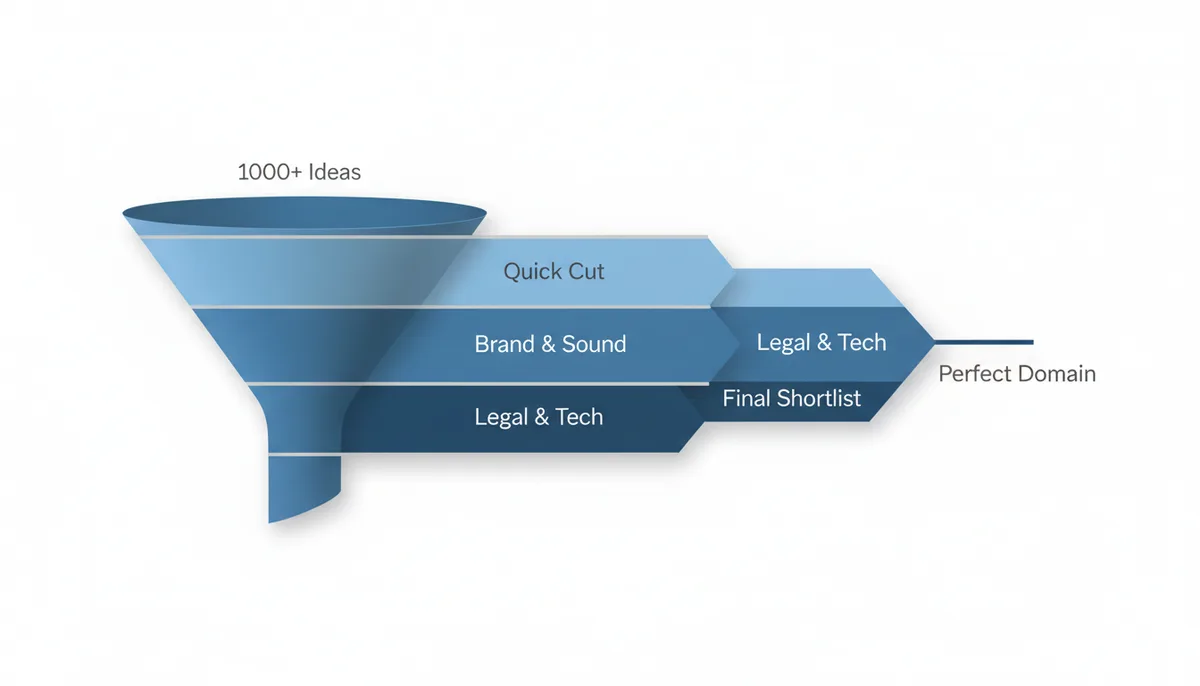
Here is the shape of it. Stage 1 cuts the list down by objective rules you can apply to a spreadsheet column. Stage 2 is where you test whether the name can actually survive being spoken, heard, and remembered by people who have no stake in it. Stage 3 checks availability, history, and legal exposure before you spend a dollar. Stage 4 is the shortlist and the decision among the few that made it this far. You will move faster if you resist the urge to skip ahead. The section that feels the most optional almost always catches the thing that would have cost you the most later.
Stage 1: The First Pass for Obvious Dealbreakers
Start by eliminating the names that fail on rules so basic they are not really opinions. This stage should remove around 80 percent of a typical generator output. If your list is 1,000 names, you want to end Stage 1 with something closer to 200, not 800. The point is to make the remaining work manageable without wasting time arguing over names that were never serious candidates.
The first rule is length. For a brandable domain, aim for under 15 characters in the name itself, not counting the TLD. That is a target, not a law carved in stone, but it matters more than most people admit. Every extra character is another keystroke a customer mistypes, another syllable that gets clipped on the radio, another chance for someone to add or drop a letter when they tell a friend. There are famous exceptions, but they are exceptions precisely because they are rare. When you are choosing from a list of generated names, almost all of the good short ones will already feel obvious. If a name needs 20 characters to say what you mean, the problem is usually the meaning, not the character count.
Hyphens and numbers are the next cut. A hyphen fails the moment someone has to say it out loud. You end up saying "hyphen" or "dash," and the listener either writes it down wrong or forgets it entirely. Numbers create the same problem in a different way. Is it "3" or "three"? Is "4" part of the brand or a version number someone will assume changes over time? A name like "3app.com" sounds fine until you realize half the people who hear it will type "threeapp.com." If you are generating names and a hyphen shows up, treat it as a signal that the underlying words probably did not combine cleanly in the first place.
Complex or unconventional spellings are a third category. Deliberate misspellings are a common generator trick: drop a vowel, swap a letter, add a suffix like "ly" or "ify" and call it brandable. Some of them work, but most of them create a permanent tax on every person who ever tells someone else your name. If you have to explain the spelling once, you will have to explain it every time. Before you get attached to a clever spelling, ask whether the corrected version is already taken by something you would compete with. If it is, you have not invented a brand; you have built a workaround for a name you did not get to buy.
You can do this pass quickly in a spreadsheet. Put the raw generator list in one column. Add columns for character count, a flag for hyphens, a flag for digits, and a note for any non-obvious spelling. Use a simple formula or pattern match to mark the ones that fail. Do not open a domain checker during this stage. Availability is downstream; you are still only asking whether the name is even worth checking.
| Domain Idea | Is it under 15 characters? | Contains hyphens or numbers? | Is the spelling intuitive? | Pass / Fail |
|---|---|---|---|---|
| quickfix.io | Yes (9) | No | Yes | Pass |
| web-solutions-hub.com | No (20) | Yes (hyphens) | Yes | Fail |
| taskrly.com | Yes (8) | No | No (deliberate misspelling) | Fail |
| getwordpresshelp.com | No (18) | No | Yes | Fail |
| ovrlay.com | Yes (6) | No | No (read as "overlay" or "overly") | Fail |
| clearpath.co | Yes (10) | No | Yes | Pass |
After this pass, your list should feel a little humiliating. That is fine. The goal was to remove the obvious failures cheaply so you do not spend the rest of the process explaining why a 22-character hyphenated name is "almost brandable." It is not. Move the survivors to the next stage and stop thinking about the rest.
How Do You Test a Domain Name's Sound and Memorability?
A domain that looks clean in a list can still fail the moment it leaves the screen. The test is whether a person who has never heard it before can say it correctly, remember it, and type it back without help. Two old rules capture most of this: the radio test and the bar test.
The radio test asks a simple question: if someone hears the name once, spoken clearly, can they spell it correctly? This is not about whether your target audience is likely to hear it on a radio. It is about whether the name contains a sound that can be interpreted multiple ways. "For" and "four" are the classic trap. "To," "too," and "two" are another. So are homophones like "right" and "write," or names where a consonant cluster is ambiguous when spoken quickly. If your name contains any of those, you are asking every new customer to make a choice in real time, and real time is where mistakes happen.
The bar test is the same idea in a noisier setting. You are in a place where you cannot control how someone hears you. You say the name once, maybe twice, and the other person has to get it right well enough to find it later. If you find yourself spelling it out, repeating syllables, or saying "it's spelled like..." more than once, the name fails the bar test. The bar test is uncomfortable by design. If it is easy, you have probably already filtered well enough at Stage 1.
There is a practical way to stress-test this without guessing. Say the name out loud three times to someone who is not involved in the project and ask them to spell it back to you. Do not coach them. Do not say the spelling first. Their first attempt is the data. If they get it wrong, note exactly what they wrote down. That tells you which part of the name is unstable. Sometimes the problem is a single ambiguous sound. Sometimes the whole thing is just hard to hold in working memory. Both matter, but they call for different fixes.
Text-to-speech tools can help you hear your own bias. When you read your own candidate list, you are already "sounding it out" the way you intend it to be said. A synthesizer will say it without that accommodation. Run the shortlist through a TTS voice and listen for the places where it stumbles or sounds ambiguous. This is not a final verdict, just a second opinion that is not you.
Phonetic ambiguity hurts word-of-mouth marketing more than it hurts anything else. A customer who likes your product but types the wrong TLD or misspells the name is still a customer who did not arrive the easy way. A name that survives the radio test reduces that friction by making the easy path also the correct one. That is not a soft benefit. It is the difference between a recommendation that sticks and one that requires a follow-up text message with the link attached.
One edge case worth naming: two-word names where the boundary is unclear. "Sunspot" and "Sun spot" are easy. But a generated name that strings together two short words can leave a listener unsure where one word ends and the next begins when heard aloud. If you would have to say "it's two words, sun and spot" just to get the spelling right, the name is carrying extra load. That load is usually visible in Stage 1 if you are paying attention to spelling intuition, but it shows up more clearly here when you actually say it out loud.
Stage 2: Gauging Brand-Readiness and Market Fit
Once the mechanical cuts are done and the sounds check out, you start asking strategic questions. This is where the process stops being only about the name itself and starts being about what the name is for. A name can pass every rule so far and still be wrong for the brand.
The first question is tone. Does the name carry the personality you want, or does it fight it? A B2B services company and a consumer app can both want a short, memorable domain, but the word shapes that feel right are usually different. A playful brand might tolerate a bouncier rhythm or a less formal word. A professional services brand usually wants something that sounds stable and does not invite jokes it did not ask for. This is not about rules; it is about whether the name makes the brand's job easier or harder. If you have to spend your whole pitch explaining why a quirky name is serious, the name is doing extra work you did not pay for.
The second question is similarity to competitors. A name that is too close to an existing brand creates two problems. One is confusion: people discover you, mix you up with someone else, and leave. The other is legal risk, which is covered in the next stage. You can catch some of this yourself by searching the candidate terms and the names of the closest competitors side by side. If the competitor's name and your candidate differ by one syllable or one suffix, that is a red flag even if no lawsuit is imminent. Confusion alone is enough reason to drop it.
The third question is how narrow the name is. A name that describes a single product at a single moment in your business can box you in. "WeFidgetSpinners.com" tells you exactly what the site used to be, and exactly what it cannot become without a rename. That does not mean every descriptive name is a trap. It means you should be deliberate about the trade-off. If you know your business will stay in one narrow lane for a long time, a narrower name can be fine. If there is any realistic chance you will expand, pivot, or add a second product line, a name that only fits today is a liability. The safest names are usually broad enough to leave room for the business you are building, not just the business you are starting.
A practical way to test market fit is to put the name in a sentence with the thing you actually sell. Not the category in the abstract. A real sentence a real customer might say. "I found it on [name]." "Send it to [name]." If the name feels odd in the sentence, the name is a problem even if it looked fine in a generator list. Generators do not know anything about your sentences, your customers, or the tone of your site. They just produce combinations. Your job at this stage is to stop treating combinations as finished ideas.
How Do You Check for Potential Trademark and Legal Conflicts?
This is the stage you do not skip because you are excited. A domain name you buy is a web address you control. It is not, by itself, a shield against someone else owning the name in commerce. If you build on a name that conflicts with an existing trademark, the downside is real: a cease-and-desist letter, a dispute under the Uniform Domain-Name Dispute-Resolution Policy (UDRP), and in the worst case a forced transfer of the domain. UDRP is the administrative process that lets a trademark holder ask for a domain to be transferred when it was registered in bad faith or conflicts with their mark. You do not want to discover this the month after launch.
Start with a structured search, not a vague feeling. Use the USPTO's current trademark search tool to check federal trademark registrations in the United States. Do not stop at the exact spelling. Search the exact name and also close spelling and sound variants, because a mark does not need to match your domain character for character to create conflict. Sort your results so live marks surface first, then review the goods and services listed for each one and note which classes they cover. A mark in one category is not automatically fatal to a different category, but the boundaries are not always intuitive. A similar name in a related industry is more dangerous than a similar name in something completely unrelated. If the current search tool returns an exact or near-exact match in a field that touches yours, record it as high risk and treat it as a serious problem, not a detail to file away.
International marks matter too if you plan to operate outside the U.S. The WIPO Global Brand Database is the place to look for trademarks registered in other jurisdictions and through international systems. Even if you only intend to sell locally now, a brand that grows can run into marks filed earlier in other markets. The search does not need to be exhaustive on day one, but it should be honest about your future footprint, not just your current one.
Then do targeted web searches. Search the candidate name with terms like "TM," "trademark," and the name of a company form if you suspect an entity already uses it. Search for the name plus the word "Inc." or "LLC" if you want to see whether a business already operates under a similar name. This is not a substitute for the official databases, but it often surfaces conflicts that a pure trademark search misses, because not every business has a registered mark and not every conflict is a federal registration.
Read the results with a clear sense of what "risk" means at this stage. An exact match in the same industry is high risk. A similar name in a related industry is also high risk and usually worth discussing with a trademark attorney before you commit. A conflict that looks distant in industry or geography is medium risk and worth a closer look. If nothing shows up, that is low risk, but low risk is not the same as guaranteed safe. This is preliminary screening, not legal clearance. You are learning enough to decide whether to keep going or walk away, not signing off on the name as safe to use everywhere.
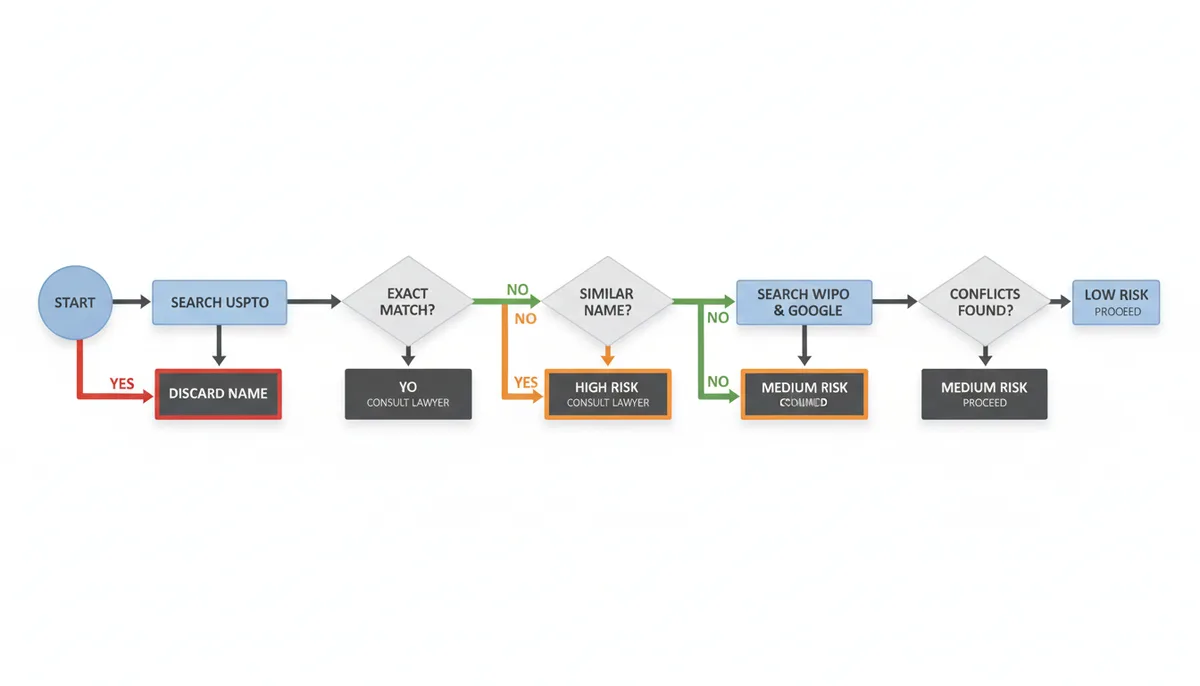
One more thing that sounds small but matters: do not confuse a domain that is available with a name that is clear. A registrar can tell you a domain is unregistered. It cannot tell you whether the name is protected by someone else's trademark. Those are different questions and they require different tools. If you conflate them, you can buy a domain that is legally awkward to use, which is the worst kind of expensive: you paid for it, and then you still cannot build on it comfortably.
This is also the stage to think about cybersquatting and typosquatting in reverse. Cybersquatting is registering a name to profit from someone else's trademark. Typosquatting is registering common misspellings of a known brand. You are not doing either, but your name can still land near a protected mark by accident. A search is how you learn that before money is spent.
Stage 3: The Technical Audit for Availability and History
After the legal screen, check the plain facts: is the domain available, what else is available around it, and what did this address do before you got here?
Availability is the obvious check. Run the surviving candidates through a domain checker that covers the TLDs you care about. If your shortlist is built around a .com, check the .com first and treat everything else as a fallback. If the .com is gone, note what is there now before you decide to use a different TLD. The wrong thing to do is buy a .io or .co without looking at the .com, because customers default to .com sometimes without thinking, and the .com owner might be a competitor, a parked page, or something worse.
Check the adjacent TLDs you would realistically want to hold. At minimum, for a serious brand, you usually want to know whether the .com, .net, and .org versions are available or who holds them. You do not always need to buy all of them immediately, but you should know the landscape. If the .com is parked and the .net is taken by an unrelated business, the practical tradeoffs change. If the .com is taken by an active competitor, that is a decision point, not just a footnote.
Social handles are not a second-level concern. A brand is easier to find when the same name is recognizable on the platforms where your audience already is. Use a handle checker to see whether the name is free on the major networks. Consistency matters more than perfection. You do not need every handle in existence. You do need the ones your customers actually use, and you need to know early if your preferred name is already claimed there so you can decide whether to adjust, add a prefix, or pick a different candidate.
Then check history. A domain can be available today and still carry baggage from a previous owner. Use the Wayback Machine to look at what the address showed in the past, if anything. You are looking for signs that the domain was used for spam, scams, adult content, or anything that would make a future search engine or a future visitor associate the name with the wrong thing. A blank history is not automatically better than an active clean history, but a toxic history is a real problem. Even if the site is down now, prior use can leave a reputation and a set of links that follow the domain.
This is also where you sanity-check the TLDs you are choosing. .com is still the default most people try first. .org carries expectations of non-commercial or organizational use. .io became associated with tech startups and in some cases carries higher renewal costs and a different audience expectation. Country-code TLDs can be a good fit if your business is tied to a place or a local audience, but they can also signal a narrower scope than you intend. Pick the TLD that matches the role you want the domain to play, not just the one that happens to be free.
How Do You Evaluate a Domain's SEO Potential?
SEO is the stage where people reach for bad rules. The old favorite is the exact match domain, or EMD, where the domain name literally contains the keyword you want to rank for. That strategy used to matter more than it does now. Google's preference has shifted toward brands and toward signals of real quality, not just a keyword sitting in a URL. An EMD can still rank, but it is no longer a shortcut, and a mediocre brandable domain is not automatically worse for search than a keyword-stuffed one.
What actually matters is less glamorous. One is whether the domain history is clean. If there is a backlink profile full of low-quality or spammy links from a previous owner, it can drag on the domain's trustworthiness whether or not the current site deserves it. A quick look at the backlink profile with a free backlink checker can tell you whether the domain arrived with junk attached. If you see a lot of unrelated, low-quality links, that is a warning sign, not a curiosity.
The second thing is search intent for the term itself. If people are already searching for the words in your domain, ask what they expect to find. If the existing intent lines up with your business, that can be useful. If it does not, you may be starting with a meaning problem. A name that people already associate with something else creates a harder job for your brand and your content. The goal is not to avoid any term anyone has ever typed; it is to avoid inheriting a meaning you would have to fight.
The third thing is domain authority in the practical sense. Do not chase the number as if it were a scoreboard. Treat it as a rough indicator of how much trust and link history a domain has accumulated. A brand new domain starts with no history. A used domain can arrive with history, good or bad. If you are choosing between a clean new domain and a used one with mixed signals, the clean one is usually the safer long-term bet for a brand you plan to build on, not flip.
A good SEO habit at this stage is to search the candidate name itself in a search engine and see what comes back. If the name already returns a competitor, a trademark holder, or a cluster of results that are off-brand, that is useful information before you commit. If the results are mostly empty, that is not automatically a selling point; it can mean nobody searches for it, which is fine for a brand but means you are not inheriting demand. Know which situation you are in.
The honest trade-off is this: a keyword-rich domain might give you a small, uncertain head start on relevance, but a strong brandable name gives you something more durable, which is a name people remember and type and link to because it belongs to you. For most businesses building for more than a year, the durable thing is usually the better bet.
Stage 4: Making the Final Decision from Your Shortlist
By now you should have a shortlist small enough to actually compare. If you still have 40 names, you did not filter hard enough in the earlier stages. If you have three to five, you are in the right place to make a decision instead of manufacturing more options.
Build a scorecard. Give each candidate the same criteria and score them the same way. Memorability, brand fit, availability of the TLD you actually want, availability of the social handles you need, trademark risk level, and history cleanliness. Keep the ratings simple. A one-to-five scale for the subjective ones, a yes-or-no for the factual ones, and a low/medium/high for the risk ones. The point is not to produce a magical number; the point is to make your choices visible so you can see what you are trading off.
| Domain Idea | Memorability (1-5) | Brand Fit (1-5) | .com Available? | Social Handles Available? | Trademark Risk | Final Score |
|---|---|---|---|---|---|---|
| clearpath.co | 4 | 4 | No | Yes | Low | Good overall; .com missing |
| ovrlay.com | 2 | 3 | Yes | No | Medium | Spelling risk outweighs .com |
| quickfix.io | 4 | 3 | No | Partial | Low | Strong, but .io limits perception |
Then get outside input on the final few. This does not need to be a big research project. Show the shortlist to people who match your audience, or to stakeholders who will have to live with the name. Ask the same practical questions you asked yourself: can you spell it after hearing it once, would you remember it tomorrow, does it fit the brand you are building. The value of this step is not that outsiders are wiser than you. The value is that they do not already know what you meant to say, which is exactly the situation your future customers will be in.
End with the gut check, but only after the hard filters. The gut check is real, and it matters, because you are the person who will have to say this name repeatedly, put it on materials, and build a brand around it. If a candidate passed the legal, technical, and memorability tests and still feels wrong, pay attention. If a candidate feels great but failed a hard filter, trust the filter. The discipline of the funnel is what makes the final feeling worth trusting.
Before you finalize, decide what you will do about fallback TLDs and variations. If you are buying the .com, consider whether you also need the .net and .org as defensive holds. If your name is easy to mistype, think about whether the common misspellings should be registered and redirected. This is not decoration. It is a small amount of upfront cost that saves you from chasing typos and copycats later.
What Are the Most Common Filtering Mistakes to Avoid?
The first mistake is falling in love before you verify. A name looks great, you start imagining the logo, and only then do you check availability or trademarks. When the check fails, you have lost time you cannot get back, and you feel the loss more sharply because you already invested emotionally. Do the objective checks first. Fall in love with a name that has already survived them.
The second mistake is skipping the history check. A domain that looks clean today can have a past that leaks into your future. A bad backlink profile or an old reputation does not always show up in a simple availability check. The cost of missing it is not just SEO. It is also trust. If people associate the address with something unpleasant, you inherit that association even if you did not cause it.
The third mistake is overvaluing cleverness. A misspelled name or a name built on a suffix can feel fresh in the generator, but freshness is not the same as usability. If the name fails the radio test, or if people constantly have to correct it, the cleverness stops feeling clever after the tenth time you explain it. A name that works quietly is usually a better brand asset than one that needs to announce itself.
The fourth mistake is underestimating the .com. A lot of people treat .com as one option among many, and in some narrow cases that is fine. But if the .com is available and the name is otherwise strong, the .com is usually the safest default for recall and trust. The risk of using a different TLD is that a meaningful chunk of people will type the .com anyway and land somewhere you do not control. If you choose a non-.com TLD, do it deliberately, not by accident.
The fifth mistake is treating the generator's output as a draft list rather than raw material. Generators are good at producing volume and combinations. They are not good at brand fit, legal safety, sound, or your specific market. The filtering process exists because the raw output is not the finished answer. If you only trim a little and stop, you are still mostly trusting the generator, and the generator has never met your customers, your competitors, or your lawyer.
Frequently Asked Questions
What if the .com is taken but other TLDs like .co or .io are available?
A .com is still the default most people try first, so when it is gone you inherit a real risk that some visitors will go to the .com by habit. That does not mean a .co or .io is automatically wrong. For a tech startup or a modern brand, those TLDs can work well and can even signal the kind of company you are. The deciding factor is what lives at the .com. If the existing .com belongs to a direct competitor, a confusingly similar business, or something that would hurt your brand by association, that is a serious problem. If the .com is parked, offline, or unrelated, the risk is smaller but still worth weighing. If you choose a different TLD, make a deliberate choice about how you will handle the traffic that defaults to .com, including whether you can eventually secure it.
Is it worth paying a premium price for a domain name that's already taken?
Sometimes, but only when the name is unusually good and the business case is strong enough to justify the cost. A short, memorable, on-brand domain can be worth a premium if it will save you rebranding later and if the price is within what the business can absorb. The downside is that premium domains can run into the thousands or far more, and for most new businesses that money is better spent elsewhere. Do not assume the seller's asking price is the only number in the room, but do not assume a negotiation is guaranteed either. For most people starting out, the practical move is to find an available name that is creative enough to be strong, rather than spending heavily on a taken one.
Should I register variations of my final domain name, such as different TLDs or common misspellings?
Yes, if you can afford it and the name matters enough to protect it. This is brand protection, and the minimum sensible version is usually to hold the .com, .net, and .org if they are available, plus any common misspellings that people are likely to type. Redirection is the point: you want the typo or alternative TLD to land on your real site, not on someone else's or on a parked page. You do not need every possible variant. You need the ones that are actually likely to be used against you or by mistake. If budget is tight, prioritize the TLDs and misspellings that are most likely to cause real confusion.
What's the difference between owning a domain name and having a trademark?
Owning a domain name gives you the right to use that specific web address. It does not by itself give you exclusive rights to the words in it across commerce. A trademark gives you the exclusive legal right to use a name, logo, or slogan in connection with specific goods or services in a certain jurisdiction. The scope is very different. A domain is one address. A trademark is a much broader legal protection for the brand itself, within the classes and regions it covers. That is why a domain can be available even when the same words are protected as a mark, and why buying a domain is not the same thing as clearing a name legally.
How much should I worry about a domain's past history if it seems clean now?
Worry enough to check. A domain can look fine on the surface and still carry history that matters. The main risk is a toxic backlink profile from a prior spam or low-quality use. Search engines can remember links and associations even after the site changes, so a clean-looking present is not always a clean history. If you find a bad history, the safer move is usually to avoid the domain unless you have a clear plan to address it. A domain with no problematic history is the simpler, safer long-term choice for a brand you intend to build on.
My generator gave me a name with a hyphen. Is it really that bad?
Usually, yes. Hyphens are hard to communicate verbally because you end up saying "hyphen" or "dash," and listeners forget them or write them wrong. They also fail the radio test more often than names without them, because the spoken name is not self-spelling. There is also a lingering perception issue: hyphenated domains are sometimes associated with lower-quality or spammy sites, not because a hyphen is inherently bad, but because it has been used that way often enough to shape expectations. A name without a hyphen is almost always easier to say, easier to remember, and easier to type. If the generator produced a hyphenated option, treat it as a sign that the raw words did not combine cleanly enough on their own.
Sources
- ICANN (Internet Corporation for Assigned Names and Numbers) — Definitions and roles of different TLDs (gTLD, ccTLD) and the function of the domain name system.
- U.S. Patent and Trademark Office (USPTO) — The process and importance of searching for existing trademarks using the TESS database to avoid infringement.
- Google Search Central Blog — Official guidance on the role of keywords in domain names, noting that domain keywords are not a ranking shortcut and domains should be chosen for users and brand clarity rather than for keyword stuffing.
- WIPO Global Brand Database — For international trademark searches and marks registered in other jurisdictions.
- Internet Archive (Wayback Machine) — The primary tool and methodology for checking a domain name's history to identify past usage that could negatively impact a new brand.
- Nielsen Norman Group — General principles of usability and cognitive load, which can be cited to support the arguments for short, simple, and memorable domain names.