How Domain Name Generators Work: Turning Seed Words Into Name Ideas
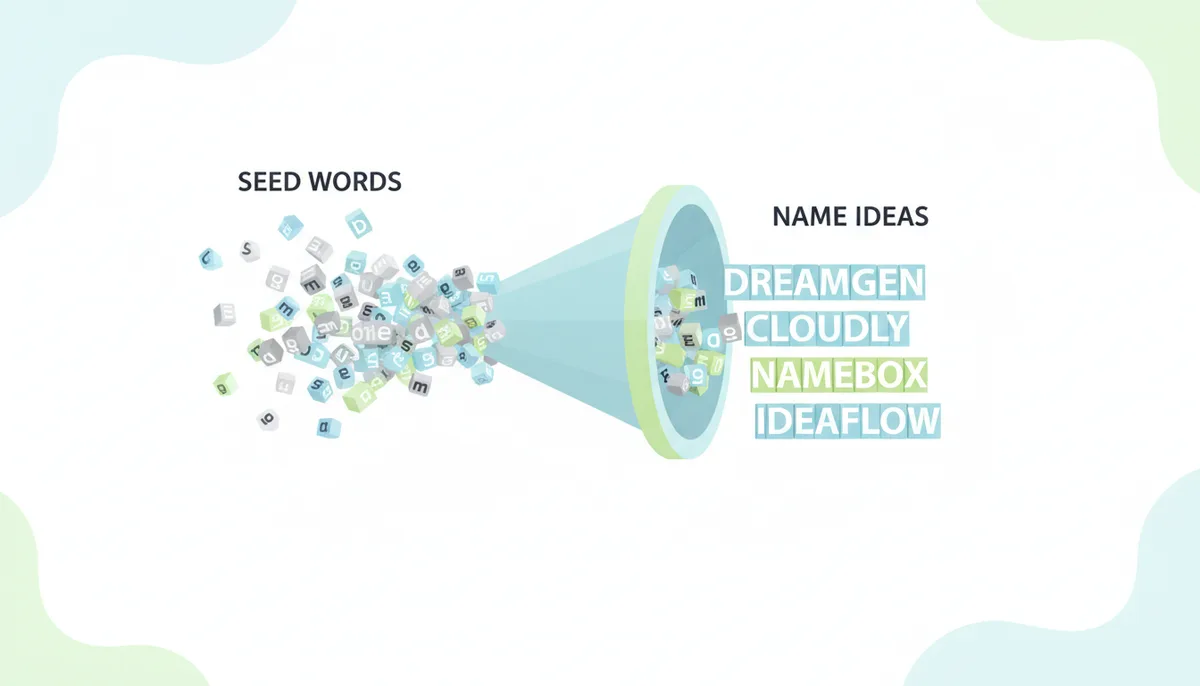
The most common complaint about domain name generators is that they produce garbage. Fair enough — but the most common cause is sitting at the keyboard. Type business into any generator and it will dutifully return businessly, ebusiness and biznexus, because you handed it a word with no edges and asked it to be creative. Type invoice software for freelance designers and the same algorithm starts handing back names you might actually register.
What happens between those two results isn't magic, and it isn't random either. It's a pipeline: combinatorial algorithms that merge and mutate words, phonetic filters that keep the output pronounceable, language models that guess what a human would find catchy, and a live availability check against the global domain registry system. Once you understand each stage, you can feed the pipeline properly — and that, more than your choice of tool, is what separates useful output from noise.
Why Don't Good Domain Names Just Come From Manual Brainstorming?
Every single-word .com was registered a long time ago. Most obvious two-word pairings went with them. Verisign's quarterly industry reports put the total count of registered domain names above 350 million across all extensions, and the IANA root zone now lists well over a thousand top-level domains (TLDs — the part after the final dot, like .com or .ai). That sounds like a lot of room. It isn't, because the namespace people actually want — short, memorable, plausible as a brand — is the most picked-over corner of it.
The deeper problem is arithmetic. Say you brainstorm the old way: a notebook, a thesaurus, a registrar's search box. You start with six seed words. A thesaurus gives you roughly ten synonyms per word, so you're holding 60 stems. Apply fifteen common affixes (-ly, -ify, get-, -hub…) and you have 900 modified forms. Compound the stems pairwise and you get 60 × 59 = 3,540 two-word combinations. Add a few hundred plausible blends and you're near 5,000 candidates. Now check each against the six TLDs you'd realistically consider: close to 30,000 strings. At twenty seconds per manual lookup, that's over 160 hours of checking.
Nobody does this. What actually happens is you check forty names, watch the good ones come back taken, get discouraged, and register something mediocre out of fatigue. Domain name brainstorming techniques fail at scale, not at imagination.
This is the gap generators fill. They automate the two tedious halves of naming — systematic enumeration and instant validation — so your job shifts from inventing candidates to filtering them. Hold onto that mental model: a generator doesn't have better ideas than you. It has all the ideas, faster than you, and taste is the part you still supply.
What Are the Basic Building Blocks of a Name Generator?
Everything starts with the seed word: the word or short phrase you type in, which anchors every transformation the tool performs. A generator is best understood as a set of functions applied to seeds. Give it different seeds and the same functions produce completely different output — which is why input quality dominates everything else.
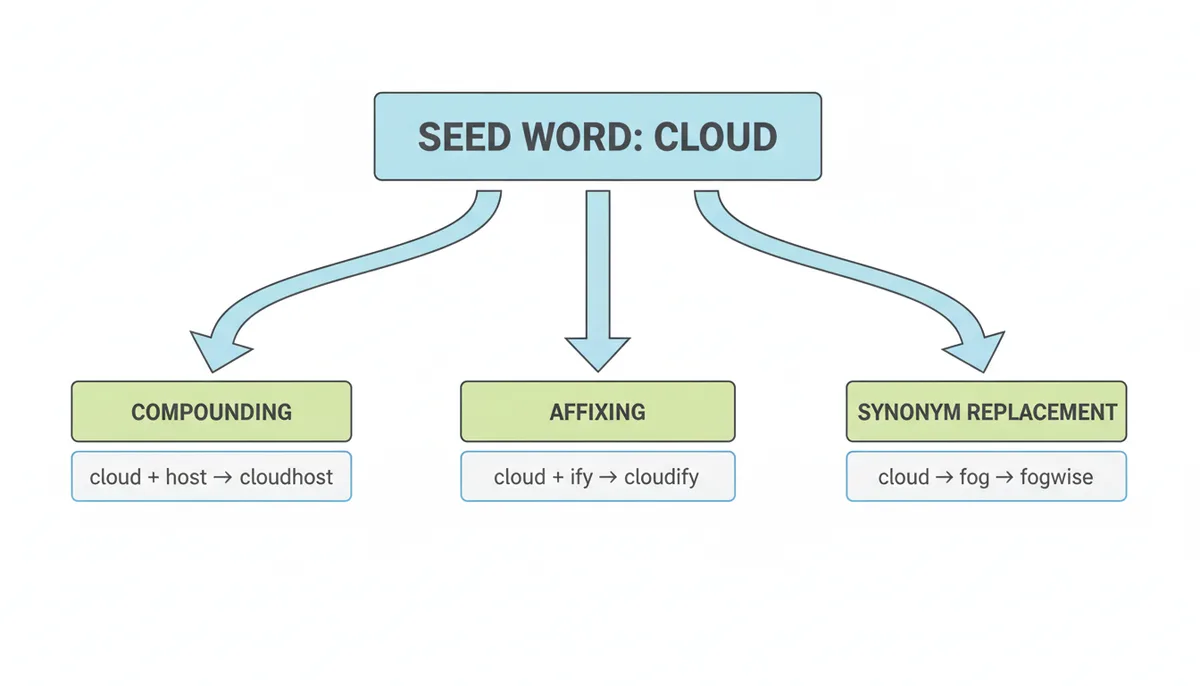
There are two fundamental operations. The first is combination (linguists call it compounding): merging whole words, the way face and book became Facebook. The second is modification, most often affixing — bolting a prefix or suffix onto the seed, the way shop became Shopify and feed became Feedly. Every generator on the internet, from the simplest free tool to the fanciest AI product, is some arrangement of these two moves plus filtering.
The third building block is the word pool. Generators don't work from your seed alone; they expand it using integrated dictionaries and thesauruses — lexical databases such as WordNet that encode synonyms, and also structural relationships like hypernyms (a sedan is a kind of car) and associated verbs and adjectives. Feed in cloud and the tool can reach for sky, storm, float, vapor. Notice how fast that gets weird — vapor is a legitimate synonym and a terrible brand direction for a hosting company. Expansion buys breadth at the cost of relevance, and every tool has to decide where to cut it off.
Finally, most tools carry an inventory of productive morphemes — the affixes that startup naming has made familiar: -ly, -ify, -hub, -base, -lab, e-, i-, my-, get-. These lists are hand-curated, which is why so many generator results have the same flavor.
How Do Generators Systematically Combine and Modify Words?
The engine room of a classic domain name generation algorithm is a set of combinatorial routines. They're simple individually; the output volume comes from running all of them over the whole word pool.
Affixing is full enumeration: seed × affix list, both directions. Prefixes and suffixes dominate because English essentially doesn't do infixes. Compounding joins whole words in both orders (A+B and B+A), and decent tools apply cleanup rules — for instance, collapsing double letters at the seam, so bright + tree yields brightree rather than the typo-magnet brighttree.
Blending is the clever one: creating a portmanteau by splicing the head of one word onto the tail of another. Breakfast + lunch gave English brunch; net + flicks gave Netflix; instant + telegram gave Instagram. Algorithmically, the tool tests every splice point along vowel boundaries and keeps the splices where both parent words stay recognizable. This is how you get names that feel coined rather than glued together.
Raw combination produces monstrosities, so the next layer is phonetic filtering. Two classic phonetic algorithms show up here. Soundex, patented over a century ago and used to index US census records, reduces a word to a rough pronunciation code — it keeps the first letter, then maps consonants to digits (b, f, p, v all become 1; c, g, k, s, z all become 2), so Smith and Smyth both encode as S530. Metaphone, published by Lawrence Philips in 1990, does the same job with far more accurate English pronunciation rules, and its successor Double Metaphone handles non-English names better. Generators use these codes three ways: to flag when a candidate sounds identical to an existing brand, to offer deliberate sound-alike variants when your first choice is taken, and to score pronounceability.
Pronounceability scoring usually adds phonotactic rules — the unwritten constraints on which letter clusters a language tolerates. English loves consonant-vowel alternation (milo, tova) and hates clusters like zxl. Practical heuristics include a reasonable vowel ratio, no three-consonant pileups that English speakers can't parse, and a length cap — my rule of thumb is that anything over about fifteen characters fails the "say it once over the phone" test.
Then there are letter-level tricks: dropped vowels (Flickr and Tumblr both shed an e, in Flickr's case because flicker.com was taken) and letter substitutions like k for c. The dropped-e era has passed; names built that way now read as dated, and I'd avoid them unless the spelling is genuinely cleaner.
The last combinatorial trick is the domain hack, where the algorithm checks whether a word can be completed by the TLD itself: del.icio.us, visual.ly, youtu.be, bit.ly. The mechanism is a reverse dictionary lookup — find words ending in -ly, -me, -us, -is, -io and pair them with the matching extension. The catch is jurisdictional: .ly belongs to Libya, .me to Montenegro, .io to the British Indian Ocean Territory, .ai to Anguilla. These are ccTLDs (country-code TLDs), and building your brand on one means accepting a foreign registry's policies, pricing and political exposure. The announced transfer of the Chagos Islands to Mauritius was enough to spark public debate about the long-term future of .io — that's the kind of risk you don't have with .com.
How Do AI and Machine Learning Create More 'Human-Sounding' Names?
Hard-coded rules have a ceiling. A rule-based system is exhaustive but tasteless: without heavy filtering it can't tell cloudify from cloudpuke, because both are legal outputs of the same rule. The shift in modern tools is from explicit rules to probabilistic models — systems that learn what names look and sound like from data.
The workhorse technique is the n-gram model. An n-gram is just a run of n characters; a trigram model learns the probability of the next character given the previous two. Trained on dictionaries and large lists of existing brand names, it learns that q is almost always followed by u, that zx essentially never opens an English word, that -ora and -ium are common name endings. Generation means sampling characters one at a time from those probabilities until the model emits an end-of-word marker. The output is novel strings that nonetheless sound like words — velora, quentia — because every character was chosen to be statistically plausible in context.
How Do Generators Handle Meaning Beyond Keyword Matching?
Feed a generator the word "java" and watch it splutter. Without context, it cannot tell whether you mean the island, the coffee, or the programming language. Simple generators treat every seed as a bag of letters; smarter ones treat it as a bag of contexts. The difference is semantic analysis, and it determines whether you get javahub or beanflow.
The technique is word-sense disambiguation. The system looks at your seed words together, not in isolation. If your seeds include "compiler" and "syntax," the model recognizes the "java" sense that clusters with "code," "python," and "program." If you added "roast" and "brew," the vector swings toward "coffee," "espresso," and "origin." This works because modern generators use dense vector embeddings — mathematical spaces where words with similar usage patterns live near one another, regardless of spelling similarity.
Once the sense is locked, the generator can perform semantic expansion instead of just synonym expansion. A thesaurus gives you "cloud" → "mist" → "fog." A semantic model gives you "cloud" → "scalable," → "serverless," → "container." These are not synonyms; they are contextual neighbors. They produce names like scalekit or containly that signal the concept without using the obvious keyword.
There is a failure mode here: over-expansion. A model trained on general web text may associate your "bank" seed with "river" because finance articles mention rivers in metaphors about cash flow. The resulting suggestions drift toward rivertide when you wanted vaultly. The fix is constraining the semantic radius — telling the generator to stay within a specific industry vector space, or manually weighting certain association chains higher.
Intent parsing adds another layer. Some generators classify your input by speech act: are you naming a tool (suffixes like -ify, -engine), a marketplace (-hub, -exchange), or a publication (-wire, -review)? This classification shifts the affix inventory. A classified "app" intent triggers short, punchy compounds; a "consultancy" intent triggers Latinate abstractions (-ence, -ity). The generator is not reading your mind; it is matching your seed distribution against labeled training data from existing company taxonomies.
The mechanics rely on models like Word2Vec or transformer variants (BERT). These don't just know that "king" is to "queen" as "man" is to "woman"; they know that "stripe" is to "payment" as "sendgrid" is to "email." In domain generation, this enables analogical naming: "Give me something that sounds like 'stripe' but for the legal industry." The model finds the vector offset between "stripe" and "payment," applies it to "law," and surfaces suggestions like counselbridge — a name that carries the fintech cadence into a new vertical. But semantic models reproduce the biases of their training data. If you ask for names "like Tesla," you may get suggestions that skew masculine because the training corpus associates the name with the male inventor. Review the output for unintended associations; the generator knows correlation, not connotation.
A Complete Walkthrough: From Business Description to Shortlist
Abstract theory collapses under contact with reality. Let us walk through a concrete naming session for a specific business: a subscription service delivering houseplant maintenance supplies — fertilizer, pruning shears, humidity sensors — to apartment dwellers in humid climates. The founders describe it as "the Blue Apron for indoor jungles."
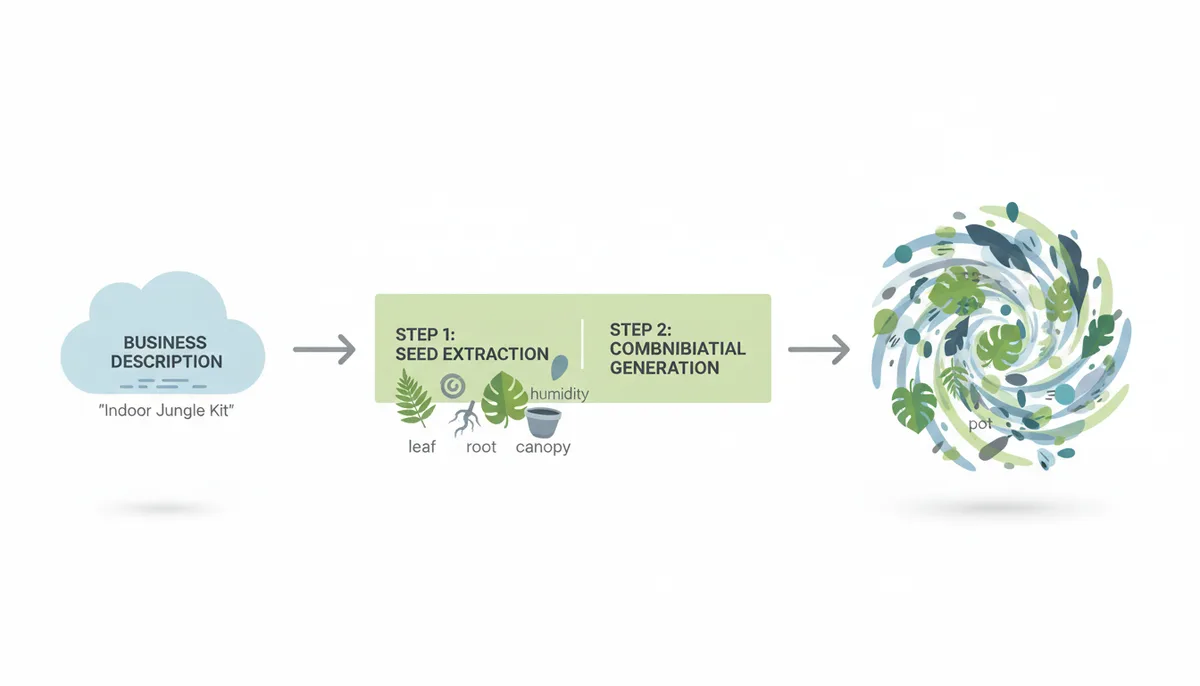
Step one: seed extraction. Do not simply type "plants." Break the description into functional atoms: fern, jungle, canopy, humidity, leaf, root, pot, apartment, urban, subscription, care, thrive. You now have twelve stems with distinct sounds and meanings.
Step two: combinatorial generation. A thorough generator will apply three operations to this pool. First, affixing: fernly, unfern, fernify. Second, compounds: urbanjungle, canopycare, rootsubscription. Third, blends: jungle + apartment = junglement (awkward), leaf + apartment = leafment (better), canopy + city = canopolis (strong). This yields roughly four hundred candidates.
Step three: availability filtering. The tool queries WHOIS for each candidate across your chosen TLDs (.com, .co, .io). In this batch, urbanjungle.com is taken (a lifestyle blog), canopycare.com is parked at $8,000, fernly.io is available. The list drops to thirty survivors.
Step four: the human filter. Say each candidate aloud. Rootsubscription is a tongue-twister; drop it. Humidityhub sounds like a dehumidifier industrial supplier; drop it. Canopolis passes the phone test and suggests scale without being generic.
Step five: social and search audit. Check Instagram and TikTok for @canopolis — taken by a Greek travel photographer. Check @canopolisplants — available. Google the exact name: no conflicting trademarks in the plant-care class, no urban dictionary definitions involving body parts. You have a shortlist.
| Candidate | TLD | Available? | Social Handle | Verdict |
|---|---|---|---|---|
| fernly | .com | No (taken) | @fernly | Dead end |
| canopolis | .co | Yes | @canopolis.co | Strong |
| leafment | .io | Yes | @leafment | Weak (sounds like "leave me") |
| urbanfern | .com | Premium ($4,500) | @urbanfern | Too expensive |
| rootly | .io | Yes | @rootly.io | Good backup |
This process took eight minutes of generation and twenty minutes of vetting. The manual equivalent — brainstorming, checking registrars, and searching social platforms — would have consumed three hours to reach the same five-name shortlist.
Why "Available" Doesn't Mean "Usable": The Hidden Failure Modes
An availability check returns a boolean: true or false. Usability is a spectrum, and generators often punt on the far end of it. The result is a name that passes every automated filter yet fails in human hands.
Visual homoglyphs are the first trap. In most sans-serif fonts, a lowercase "l" and an uppercase "I" are identical rectangles. The domain googIe.com (with a capital I) is visually indistinguishable from google.com in browser address bars. Worse are "rn" (r+n) versus "m", or "vv" versus "w". A generator might suggest fernly when fermly is taken, but if the user misreads it as fermly (firmly), the brand loses its plant association entirely. Always copy the suggestion into a plain text editor and cycle the font to expose these ambiguities.
Toxic history haunts expired domains. A name might show as available because the previous owner let it lapse, but that previous owner could have been a spam pharmacy or a link farm. The domain carries a "red flag" history in Google’s index that takes months to purge, if it can be purged at all. Check the Wayback Machine for snapshots; if the domain ever hosted a "weight loss miracle" page, abandon it. SEO-focused generators sometimes integrate backlink APIs (Majestic, Ahrefs) to flag domains with historically toxic profiles, but most free tools skip this.
Phonic collision occurs when a spelled name sounds like a different word or phrase. LeafsExpert suggests cannabis (leaf) to a North American ear, even if you meant foliage. Phonetic algorithms catch spelling variations, not semantic sound-alikes. Say the candidate to three people who have not seen the spelling. If two hear something else, kill it.
Social fragmentation is the silent killer. You secure canopolis.co, but @canopolis on Instagram is a travel influencer, @canopolis on Twitter is inactive, and Canopolis is a cat sanctuary in Oregon. Your customers will tag the wrong accounts and email the wrong contact forms. Before finalizing, audit the exact handle across at least Instagram, TikTok, LinkedIn, and Twitter/X. If the handle is taken in your sector, even if the domain is free, consider the name compromised.
Cross-cultural negatives hide in affixes. The suffix -as is common in Lithuanian names but looks inert in English. However, canopas resembles "can of piss" when spoken quickly. The substring cum appears in legitimate Latin-derived words (cumulative, circumference) but triggers automatic filters and juvenile humor. Run your shortlist through an urban dictionary search and a phonetic simulation of common accents.
Generator, Crowdsourcing, or Agency? Matching the Tool to the Stakes
Domain name generators are not the only automated option, nor are they always the right one. Understanding the cost frontier helps you decide when to push a button versus when to write a check.
Free and freemium generators (cost: $0–$50) offer volume without judgment. They excel at brute-force enumeration: give me every compound of "cloud" and "security." They fail at cultural nuance and trademark depth. Use them when you are pre-revenue, testing a concept, or need a placeholder domain for a prototype. Do not use them to name a funded startup where the cost of rebranding later exceeds $10,000.
Premium algorithmic tools (cost: $100–$500/year) add semantic filtering, multi-language checks, and brandable "empty vessel" name generators that use phonetic algorithms to invent pronounceable nonsense (think "Kiva" or "Zappos"). These are worth the subscription if you run multiple naming projects annually or need names across different languages. The ROI threshold is around three naming exercises per year; below that, the free tier suffices.
Crowdsourcing platforms (cost: $200–$2,000) pit hundreds of human contestants against your brief. You get creativity without hiring a full agency. The quality variance is extreme — you will receive 400 entries, 380 of which ignore your brief — but the 20 good ones often include angles no algorithm would hit. Use crowdsourcing when you have a specific linguistic constraint (must work in Japanese and Portuguese) or when you need social proof that "real people" like the name. The risk is legal: crowdsourced names often skip trademark pre-screening.
Boutique naming agencies (cost: $5,000–$50,000+) deliver linguistic strategy, trademark screening by actual IP attorneys, and a shortlist of 6–10 names that have passed preliminary USPTO or WIPO searches. They also provide rationale: the story you tell investors about why the name works. This is the only route if you are entering a crowded trademark space (fintech, health tech) or if your name must survive international markets where accidental obscenity is costly.
| Method | Cost Range | Time to Shortlist | Best For | Hidden Cost |
|---|---|---|---|---|
| Free Generator | $0 | 1 hour | Side projects, MVPs | Rebranding if you scale |
| Premium Generator | $100–$500/yr | 30 mins | Serial entrepreneurs | Subscription fatigue |
| Crowdsourcing | $200–$2,000 | 1 week | Specific linguistic needs | Legal vetting not included |
| Naming Agency | $5,000+ | 4–8 weeks | VC-funded startups | Opportunity cost of delay |
The hybrid workflow is usually optimal: use a generator to produce 200 candidates, manually filter to 20, then pay a trademark attorney for a knockout search on the final three. This splits the difference between algorithmic speed and legal safety.
The Edge Cases That Break Generators: IDNs, Emoji, and Registry Traps
Generators assume an ASCII Latin character set and standard generic TLDs. Venture outside that reservation and the tools start lying to you.
Internationalized Domain Names (IDNs) allow non-ASCII scripts — Cyrillic, Arabic, Chinese — in domain labels. Technically, these are encoded as Punycode, a prefix of xn-- followed by ASCII gibberish. münchen.de becomes xn--mnchen-3ya.de. Most generators cannot generate or verify these. Worse, homograph attacks use visually identical characters from different scripts: a Cyrillic "а" (U+0430) looks exactly like a Latin "a" (U+0061). A generator might suggest apple.com (with Cyrillic a) that resolves to a phishing server. If you need global names, verify character codes in a Unicode inspector, not just the generator's output window.
Emoji domains technically exist in the DNS. You can register xn--i-7iq.ws (which renders as 😀.ws) because the .ws registry allows it. However, email validation regexes across the internet choke on emoji. Your customers cannot sign up for your newsletter. Your SSL certificate might fail. The major generators ignore emoji inputs entirely; if you are tempted by the novelty, know that you are building on quicksand.
Single and double-character domains are almost universally reserved by registries. ICANN restricted single-character .com names decades ago; many ccTLDs followed suit. A generator might report a.io as available because the API returns a strange status code, but the registry will reject the transaction. Similarly, "premium" names — single dictionary words like wine.com or ai.io — are technically available but priced at $50,000+. The generator's binary "available/unavailable" flag flattens this critical price distinction.
Reserved words vary by TLD. Many country-code registries block registration of country names, city names, or terms like "bank," "insurance," or "university" without specific licensure. A generator checking .de (Germany) might suggest bankberlin.de, but DENIC will reject it without proof of a banking license. The tool sees the DNS as a database; the registry sees it as regulated infrastructure.
Finally, special-use domains defined by RFC 6761 — like localhost, invalid, and test — should never appear in generator results, but poorly programmed tools scraping dictionaries might suggest them. These resolve only in specific local contexts and will not work on the public internet.
When in doubt, query the specific TLD's registry directly through their EPP interface or a registrar that specializes in that ccTLD. The generator is a blunt instrument; the registry rules are a minefield.
Sources
- ICANN (Internet Corporation for Assigned Names and Numbers) — Claims about the domain name system's structure, the role of registrars, and the official process for registering a new domain.
- IANA (Internet Assigned Numbers Authority) — The definitive list of all valid Top-Level Domains (gTLDs and ccTLDs) that a generator's availability checker must query against.
- U.S. Patent and Trademark Office (USPTO) — The claim that domain availability is separate from trademark rights, and that users must conduct a separate trademark search for their business name.
- Stanford Natural Language Processing Group — The technical concepts behind advanced generators, such as semantic analysis, n-grams, and other NLP methods for understanding and generating language.
- ArXiv.org — Claims about the use of specific machine learning models (like Markov chains, GANs, or transformers/LLMs) in generative language tasks, which is the academic foundation for AI name generators.
- The WHOIS Protocol Specification (RFC 3912) — The technical explanation of how real-time domain availability checks are performed by querying WHOIS servers, as specified by the Internet Engineering Task Force (IETF).