How to Read Your Domain Lookup Activity Before Choosing a Final Name
You searched 173 times. You checked brewly, coffeeblog, originroast, dailygrind. You watched the results flash back taken, premium, available, and you closed the tab with nothing registered. That doesn't mean you wasted an afternoon. It means you generated a dataset without knowing it.
Every lookup you perform is a vote for something. A search for cortexai says you like synthetic brandable names. A search for denvercoffeecompany says you lean descriptive and local. The TLD you keep landing on — .com, .io, .co — says what you think the internet puts trust in. Stitched together, that history reveals a brand personality you've never had to articulate. Most people skip this step. They either register the first available name that doesn't hurt their eyes or offer on the most expensive one they can allegedly afford. Both moves are wrong, and both happen because nobody teaches the method in between.
This guide turns your chaos into a decision. You'll learn how to capture what you've already searched, how to extract themes you didn't know you had, how to score the top contenders instead of guessing, and how to vet a shortlist against trademark registries, social media handles, and the Wayback Machine. By the end, the "perfect domain" stops being a feeling and becomes a calculated score.
1. Why Your Search History is a Goldmine for Decision-Making
Ask a founder to describe their ideal domain and you'll hear a blur: "Short, professional, maybe has a keyword, definitely a .com." But ask that same founder what domains they've already looked at and you'll get a list with twenty times more specificity. What you've searched is far more honest than what you can describe.
The reason is behavioral. When you type a name into a lookup tool, you're not consciously evaluating your business strategy. You're following instinct and word association. That instinct carries a signal. A person who searches syndicate.io, haven.capital, and verge.today has a taste for abstract, institutional metaphor — regardless of what their branding deck claims. Meanwhile, someone who searches bestdogwalkerinc.com is telling you a different story about themselves: they value clarity over expression, and that's a legitimate branding orientation, too.
The practical payoff of understanding this pattern is a trait called decision confidence. When you can point to five columns in a spreadsheet and say "60% of my searches contained the keyword craft, and the two brandable names I keep revisiting are both two syllables and start with a hard C," you're no longer picking a name. You're concluding a pattern. And conclusions are far easier to commit to than guesses.
There's also a second layer: your search history exposes evolution. Early on, you likely searched exact-match keywords — bestplumberlondon.com, londonplumberpro.com. Two weeks later you searched pipely, flowworks, taproot. That shift is real signal. It shows your positioning matured from "I need keywords in the name" to "I need a name that can become a brand." Acknowledging that shift, rather than reaching back to register that early keyword URL, is often the difference between a smart domain and a desperate one.
Finally, your history is a goldmine because it's unpaid market research. When you search a name and get taken, that's the market telling you someone else believed in the same word. When you search a set of coffee names and half come back taken, that's a market density signal — a strong one. When not a single name in your theme is available for a standard registration fee, you should hear the market saying "this category is crowded, be ready to pay up or get creative." More on interpreting those signals in Section 6.
2. How to Capture and Structure Your Lookup Data
Your lookup history lives in three places right now, probably. Local browser history (the list may only span a few sessions before they get erased), the research tab inside a tool like the Domain Lookup Tool, and inside your own memory, compressed to a handful of favorite names. The goal is to consolidate those three into a single spreadsheet that you can sort, filter, and count.
Start by exhausting the easy exports. If your lookup tool has a history feature, export it to CSV. The Domain Lookup Tool, along with bulk WHOIS checking, lets you see groups of results at once; use that to refresh your memory of what you searched. Otherwise, open a new spreadsheet in Excel, Google Sheets, or even Airtable. If you're starting from a blank slate, this will take an hour. That hour is the most valuable hour in the entire domain research process — it's the one where you build the artifact that everything else hangs off of.
For every domain you've seriously considered, create one row. The golden rule of this spreadsheet is one consistent column scheme. Use these exact columns, no matter how redundant some feel:
| Domain Name | TLD | Status | Price | Primary Keyword | Theme | Notes |
|---|---|---|---|---|---|---|
| brewly.com | .com | Aftermarket | $2,800 | brew | Two-syllable verb | Great sound but pricey |
| originroast.io | .io | Available | $45/yr | origin | Geo-story | Feels startup-y, explains more |
| dailygrind.co | .co | Available | $38/yr | grind | Habit/metaphor | Everyone knows the phrase |
| firstcupcoffee.com | .com | Taken | — | coffee | Descriptive two-word | Too long, not brandable |
| singularcup.com | .com | Available | $12/yr | cup | Abstract adjective | Memorable, sounds premium |
Note how the Status column has three distinct banks: Available (you can register at standard price), Premium (the registry prices it hundreds or thousands of dollars), and Aftermarket (someone else owns it, offered on Sedo, Afternic, or a registrar auction). Don't blur these. They behave differently and your strategy for each must differ.
Placeholder for notes is where the real insight lives. The exact phrase you thought when you saw the name — "sounds like a bike brand," "easy to spell?" — that's the qualitative layer your spreadsheet will use to later explain why certain names feel different. Write it down, even if it's slurring.
Keep the data entry consistent. Use lowercase everywhere. Never put commas in a cell to list keywords — use a separate column or a single semicolon delimiter. Sort columns by the theme you plan to analyze. The structural rule is simple: if you can't filter by it or sort by it, it doesn't belong as a column.
If you're missing data (you never logged the first session, or you can't find the price for an aftermarket name), write "Unknown" rather than dropping the row. The missing cell is a signal too, and it's rarer than you think.
3. Decoding Your Search: How to Find Key Themes and Patterns
Now the spreadsheet has 100 rows (or 400, if you're thorough). Your job is to turn them into four or five buckets of intent. Here's the system that works.
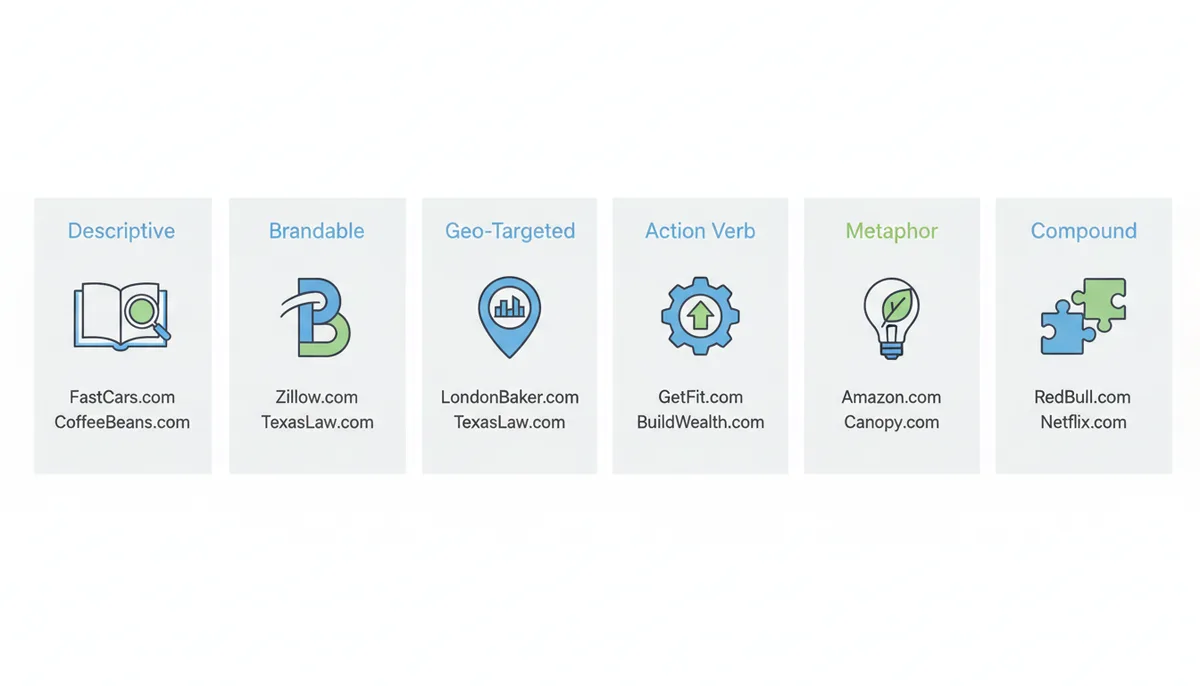
The bucket list. Create a new column called Category and assign one of six labels to every row:
- Descriptive — the name says exactly what you do ("coffeeblog.com")
- Brandable — the name suggests, not states; often a made-up word or abstract concept ("brewly")
- Geo-Targeted — includes a city, region, or country ("londonplumber.com")
- Action Verb — starts with a doing word ("launchly", "growops")
- Metaphor — a word that evokes a feeling or image ("nexus", "orbit")
- Compound — two words joined with no space ("coffeecraft")
Do this quickly. Rely on your Notes column if you kept one. The goal is not perfection — it's distribution. When you're done, filter by Category and count. "Tell me I have 30% Descriptive, 30% Brandable, 20% Geo-Targeted" is a revelation. It tells you where your instincts push you, and it gives you permission to think about what you actually want.
Keyword frequency. Use COUNTIF (Excel and Google Sheets both support it). Set up a list of every substantive keyword that appears across your Primary Keyword and Notes columns, then run COUNTIF on the range. In a coffee shop project, you might find that brew appears 14 times while coffee appears only 6 — a meaningful vote for ritual verbs over the category noun itself. Document the top ten keywords and their counts. That's your personal thesaurus.
TLD patterns. Filter by TLD. What percentage are .com? Do you have a hidden habit of adding .io? Maybe your first session was 90% .com and your last session is 60% .co — that's a real angling toward modern tech naming styles. Note the proportions, not just the product.
Time evolution. Sort by a date column, if you kept one. Identify the first 20 lookups and the last 20 lookups. Compare their categories and keywords. When teams do this exercise, they almost always discover they started with keyword-heavy, exact-match names and drifted toward brandable, abstract options as the business concept crystallized. That's not a bug — it means you'd mature from trying to label yourself to trying to become a name. If that pattern holds, make sure the shortlist leans toward the later side of your search history.
Once you've grouped, counted, and trended, take a step back. Draw three conclusions from your history:
- The top 5 thematic buckets your name ideas live in
- The top 3 keywords that appear most often
- The shift, if any, from descriptive to branded
Write these down. They become the guardrails for everything else.
4. From List to Shortlist: Creating a Domain Scorecard
A generic domain list of 100 names is useless. A shortlist of 10 names is still unruly. A weighted scorecard for 5 names is where decisions happen.
The method: define the criteria that matter, assign each a weight, score each domain 1–10, and multiply. This removes the "It just feels right" bias and makes you consciously decide what "right" means.
The criteria. Use these five, or a trimmed subset:
- Brandability — could this become a real brand, or does it sound like a parameter name?
- Memorability — can a listener repeat it back to you after hearing it once?
- Length — shorter wins. Under 10 characters is ideal; under 15 is workable
- SEO Value — does it include a keyword your customers type into Google?
- TLD Trust — .com gets a 10, .io a 7, .co a 7, everything else leans lower
Now the weights. Your weights must reflect your actual business goal, not fashion. A local plumber with a weak website? Weight SEO Value at 40% and Brandability at 15%. A venture-backed software startup that needs a logo as much as a URL? Flip those numbers. There's no universal set; the scorecard is only as smart as its weights.
| Domain | Brandability (30%) | Memorability (25%) | Length (15%) | SEO Value (20%) | TLD Trust (10%) | Weighted Score |
|---|---|---|---|---|---|---|
| cortexai.com | 9 | 8 | 7 | 6 | 10 | 7.95 |
| neuroflow.io | 8 | 7 | 8 | 5 | 7 | 7.05 |
| nexusdata.com | 6 | 5 | 7 | 8 | 10 | 6.70 |
| buildly.io | 5 | 6 | 7 | 4 | 7 | 5.55 |
For example, cortexai.com scores (9 × 0.30) + (8 × 0.25) + (7 × 0.15) + (6 × 0.20) + (10 × 0.10) = 7.95. How to read the rest of that table: cortexai.com wins because it lands at the intersection of strong brandability, memorability, and high-trust .com TLD. The calculation is iterative: if your weights lean heavily toward SEO and your market is a high-competition keyword space, nexusdata.com would vault to the top. The scorecard's power is that it turns a debate between two founders into the simple question, "Which criteria do we actually keep?"
Score your top 5–10 from your themed list. If a domain scores below 6 overall, cut it. Whatever remains, you'll be able to defend to a partner, an investor, or a future version of yourself.
5. How to Vet Your Top Contenders Against the Real World
A scorecard says a name is good on paper. The real world has a way of disagreeing — through a trademark, a squatter, or a previously used name now associated with something you want to avoid. You have to vet before you commit.
Trademark search. For US-based businesses, go to the USPTO's Trademark Search system (formerly known as TESS). Type in your domain's core word or phrase. If you find an existing live trademark for identical goods or services, walk away — even if the domain is available for registration. The expensive legal problem is not the domain; it's the trademark that someone else owns. For a quick patent, that search takes 20 minutes. Spend it. Also run a quick WIPO UDRP search if your domain uses a made-up name that looks like a known brand; UDRP panels have shut down exact-match domains in the past.
Social media handles. Nearly any real business needs at least an Instagram, X, Facebook, LinkedIn and TikTok handle. Check all of them for each shortlisted name. It is a permanent pain to find one free handle and have four taken. Use a free tool like Namecheckr or check each platform directly. A "no conflict" is worth a bonus point to the scorecard.
The wayback machine. Open the Internet Archive Wayback Machine on archive.org and type in your sentinel domain. If a site history comes up, look at what the site was about. A former adult site, a scraper blog, or a page full of spam links will drag down your SEO even if you own the name now. The wayback won't show everything, but it shows enough to save you from buying a forgotten landmine.
Cross-language check. Run the word through a few translation engines, or ask a native speaker if you have one at hand. A great-sounding English name can be an insult in an adjacent language. E.g., "daily" and "gift" mean something different across borders. The rule: if your market is global, check English, Spanish, French, German, and ideally the language of any major market you plan to enter.
Google Trends sanity check. Put the core word into Google Trends. If it's a rising trend, nice. If it's a flatline or a decline, think about whether you want to ride it. In 2024, almost every business faces this: a name that's perfectly brandable but tied to a declining search term is a long-term drag.
This vetting stage is what takes a solid scorecard leader and turns it into the right name — or exposes the leader as a trap. Always do it before you spend.
6. What Availability and Pricing Tell You About the Market
When you search a name and it returns available, taken, or premium, you're reading the market's judgment of that name. Learn to interpret the difference.
A standard registration (typically $10–$15/year for a .com) means no one has registered it or it has recently lapsed. That's the cheapest outcome, but it has an inverse reason behind it: a name that's available at standard price is often available because it's not valuable. Not always — sometimes a niche word combination sits unregistered because the ideal buyer is rare. But the signal exists.
A premium domain is priced by the registry (the company that controls the TLD) and usually carries a four or five-figure price tag. For .com, registry premium pricing appears on so-called "category-defining" words. When you see a premium domain in your search, note what it says about your keyword. If your category's core word is premium, that's evidence of demand for that term — use it, but decide if you want to pay the premium or find a cheaper brandable phrase around it.
An aftermarket domain is owned by someone else. It appears on marketplaces like Sedo and Afternic, often with an opening ask. Aftermarket names come from expired domains, bulk investors, and businesses that failed. You can negotiate. Some carry traffic; most don't. The trade-off is time and money: you can wait weeks for a negotiation, or you can pay the asking price today and move on.
Here's the key insight on availability as a market signal: count your taken results inside a single theme. If 8 out of 10 coffee names you like are already taken, the coffee naming space is dense. That doesn't mean you shouldn't buy a coffee domain; it means you should expect to pay up or get more creative. If a theme keeps producing available names, you have found a sweet spot: low competition, cheap entry. A theme with lots of premium results is a theme where the market has already assigned it value — decide whether the value is real for your business or just registry greed.
When your favorite is taken but available on the aftermarket, your options are simple:
- Make an offer through the marketplace or registrar. Offers take a few days.
- Backorder it. A backorder service will watch for the domain's expiration and attempt to grab it when it becomes available — useful if the current owner is a squatter who doesn't renew.
- Pivot using the pattern you discovered. Remember that recurring keyword from your history? Invent a new combination around it. It's often cheaper and fresher.
One more thing to know: pricing isn't permanent. Domain registrars and marketplaces sometimes run specials on TLDs. If your top pick is a .co at $38/year, set a reminder to check before you renew at a higher rate; the promo cycle exists and a small discount over two years is real money.
7. Analysis Traps: Common Mistakes in Reviewing Your Lookups
Even with a clean spreadsheet and the right scorecard, you can ruin the analysis by falling into one of four traps. Know them, and name them when you catch yourself drifting.
Analysis paralysis. Research can turn into a procrastination treadmill. Every new search result gives you a fresh dopamine hit of possibility, and the spreadsheet tenaciously grows. The professional fix is to set an endpoint before you start: "After I've logged 200 lookups, I stop searching and I score my shortlist." When you hit the line, close the search tabs. The next search will only draw you deeper into a progressively less productive space. Commit to deciding on a Friday at 4pm. You'll be done by 5.
Sunk cost fallacy. The more time you spend researching a single name, the more delightful that name starts to seem. It's the same mental effect that keeps people in bad jobs. Resist by checking how many of the names in your spreadsheet are actually good and not just familiar. If a name scores a 5 but you've checked it 40 times, scoring a 6 because of the 40 times is a distortion. Delete the history of your feelings and look at the spreadsheet.
Over-indexing on exact-match domains. Twenty years ago, having "london-plumber.com" — punctuation included — guaranteed a search rank. Modern Google has detrained so heavily on brand signals that an exact-match domain no longer carries a meaningful ranking advantage. What carries a ranking advantage is a name that gets typed, clicked, and trusted. A brandable buildplumbers.com will outrank a stale professionalemergencylondonplumber.com if the rest of your site is solid. Use the exact-match instinct as a theme hint, not a buying rule.
Confirmation bias. When you've fallen for a name, you'll read its availability report as validation and look past red flags. The wayback machine shows a defunct gambling website? You'll tell yourself "it's fine, we're totally different." It probably isn't. Force yourself to run the same vetting process on your top three, not just your crush number one. If you can't do that, ask someone else to run it for you. Outsiders see the flags more easily.
8. Putting It All Together: A Start-to-Finish Decision Workflow
Here's the workflow, end to end. A clear sequence you can run next week and reuse for your next project.
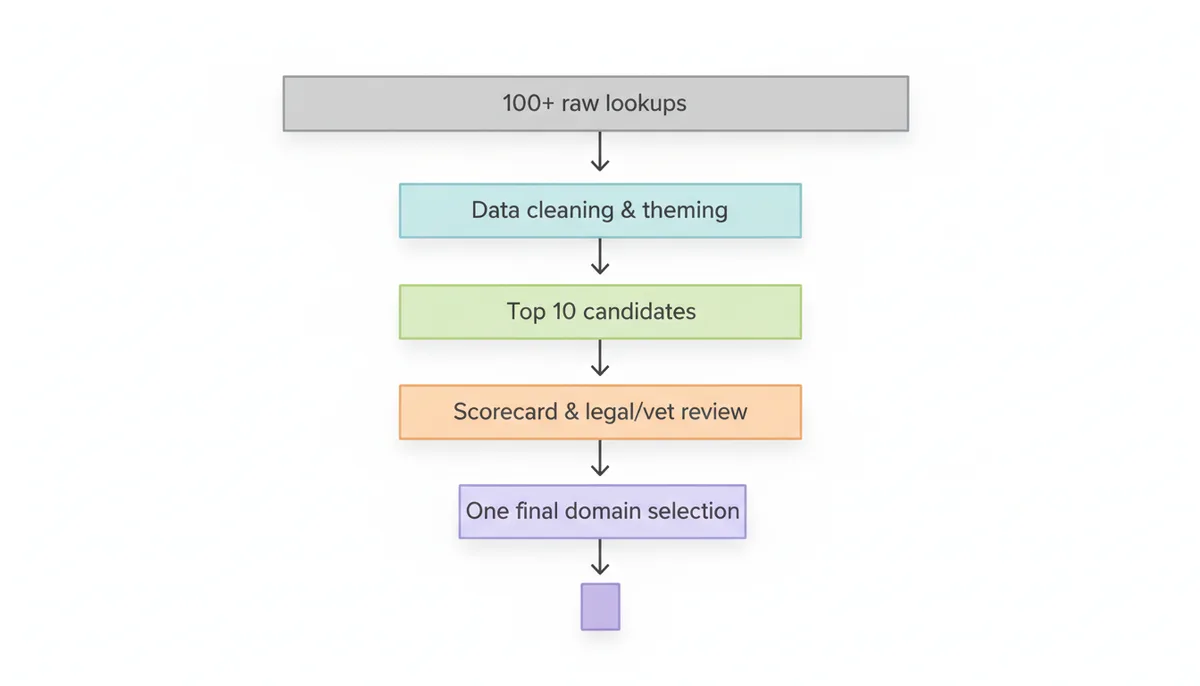
- Capture everything. Consolidate browser history, tool history, and memory into one spreadsheet with the column scheme from Section 2.
- Clean and theme. Assign every row a category and keyword. Use COUNTIF to find your top themes and TLD distributions.
- Cut to 10. Eliminate anything that fails a basic sanity check (too long, too obscure, bad notes). Keep your top 10 by feel.
- Score. Set your weights per business goal. Score each domain. Accept the number even if it surprises you.
- Vet the top 3–5. Run trademark, social media, wayback, and cross-language checks. Remove anything with a fatal real-world flag.
- Decide within 24 hours. Pick the winner. Register it immediately — even at a premium price if the spreadsheet justifies it. Then move on to building.
To see it in action, walk through a real-ish scenario: a coffee blog, 150 lookups.
Grace spent two weeks searching coffee names. Her spreadsheet has 150 rows. The analysis: the top keyword is brew (14 appearances) — more than coffee (6). Her categories break down as 40% descriptive, 35% brandable, 25% metaphor. She trends from "coffeecraft.com" in session one to "dailybrew.co" by the end. She scores her top three:
| Domain | Brandability (25%) | Memorability (30%) | Length (15%) | SEO Value (15%) | TLD Trust (15%) | Weighted Score |
|---|---|---|---|---|---|---|
| dailybrew.co | 8 | 9 | 8 | 6 | 7 | 7.85 |
| singularcup.com | 9 | 7 | 7 | 5 | 10 | 7.65 |
| originroast.io | 7 | 6 | 7 | 7 | 7 | 6.70 |
The weighting favors memorability — Grace wants a name people will remember after one podcast mention. dailybrew.co scores highest. The vetting round confirms: the trademark search is clean, the @dailybrew handle is available, and the Wayback Machine shows no prior history. She also checks @singularcup and finds it taken on Instagram. That's the final nail. She registers dailybrew.co.
Was this a slam dunk? No. It took a process. The process produced not just one name but a clear rationale for it. When someone asks Grace "why dailybrew?," she won't say "because I liked it." She'll say, "Because my search history showed I value ritual verbs, my brand benchmark is memorability, and the vetting cleared the name in every jurisdiction I care about." That's the confidence the workflow gives you.
In the end, a domain name is a strategic asset. Your method should treat it like one.
Frequently Asked Questions
What if my absolute favorite domain name is already taken?
Don't give up immediately. First, check aftermarket platforms like Sedo and Afternic — a taken name is often for sale. If the owner is asking a price you can stomach, negotiate. If it's not listed, you can place a backorder through a service that will try to catch it if the current owner lets it expire. When none of that pans out, use the themes you found in your search history as fuel. The name you liked probably had a structure and a keyword you can recombine into a new name. Most of the time, the backup ends up being cheaper and fresher.
How much should I be willing to spend on a premium domain?
That number comes from your budget, not the market. A premium domain can be worth the money if it's short, memorable, and category-defining — those assets can save tens of thousands of dollars in marketing later. But if you're pre-revenue, a $20,000 domain is a terrible place to park cash that could fund product development or early hires. The rule of thumb used by brand agencies I respect: the cost of a premium domain should be under 2% of your projected marketing spend over three years. That either gives you a clear "go" or a clear "no" without agonizing.
Is a .com domain still the most important TLD?
For global businesses, yes — .com is still the automatic trust signal. Typing a .com into a browser after hearing it mentioned on a podcast is a reflex. That said, the reflex is starting to fade. For tech startups, .io and .ai are increasingly recognizable and even trendy. For a local plumber in Munich, a .de domain might beat a .com. What matters is that your target audience perceives the TLD as normal. If they have to pause when they hear "dot-something," you lose the brand value. Use .com unless you know your audience will not flinch at the alternative.
How long should this entire analysis process take?
For a serious project, set aside a focused day — four to six hours. The goal isn't speed; it's seeing the full picture before you write a single check. The capture step takes an hour, the theming another hour, the scorecard an hour, the vetting two hours. Spending one day this way saves years of regrets. If you're the type who loves the research phase more than the decision phase, set a hard deadline. The process is done when you have a weighted score, not when you feel perfectly sure.
Are there any tools that can automate this analysis?
Yes and no. The domain lookup and bulk checks are easily automated — tools like the Domain Lookup Tool handle that part. But the core analysis — what words you keep searching, what TLD patterns you return to, what category your instincts lean toward — is best analyzed in a spreadsheet. Google Sheets and Excel can sort, filter, COUNTIF, and pivot table their way through 200 rows in seconds. The manual work is the valuable part: labeling each name with your honest note is something an algorithm can't do for you, because the notes are where your brand taste lives.
What's the biggest mistake people make after shortlisting domains?
Skipping the due diligence. They find a name that's technically available and register it within minutes, delighted by the price. Then, a month later, they discover a competing trademark in a neighboring country, or the social handle is taken, or — worst of all — the Wayback Machine shows the domain used to host porn sites or spam. That last one tanks your email deliverability and your SEO on day one. Always run the vetting before you register, even if it feels like a formality. It's the only thing standing between you and a really expensive regret.
Sources
- ICANN (Internet Corporation for Assigned Names and Numbers) — Definitions and policies regarding gTLDs, ccTLDs, and the function of the domain name system (DNS) and WHOIS.
- U.S. Patent and Trademark Office (USPTO) — The methodology for conducting a basic trademark search (using the TESS database) to vet potential domain names against existing brand names.
- WIPO (World Intellectual Property Organization) — Information on the Uniform Domain Name Dispute Resolution Policy (UDRP), which is relevant when discussing the risks of choosing a name similar to a trademarked one.
- Internet Archive (Wayback Machine) — The practice of checking a domain's history to see what kind of website existed on it previously, which helps avoid acquiring a domain with a spammy or negative past.
- Google Trends — The process of validating the popularity and search interest over time for keywords identified during the domain lookup analysis.